
What Is the ACL?
The anterior cruciate ligament is one of the major stabilizing ligaments of the knee.
It contributes particularly to control of forward movement and rotational stability of the tibia relative to the femur.
ACL injuries are common in sports involving:
- Sudden changes of direction
- Pivoting
- Cutting
- Landing
- Deceleration
- Contact injuries to the knee
An ACL injury can occur alone or together with damage to the meniscus, cartilage or other knee ligaments.
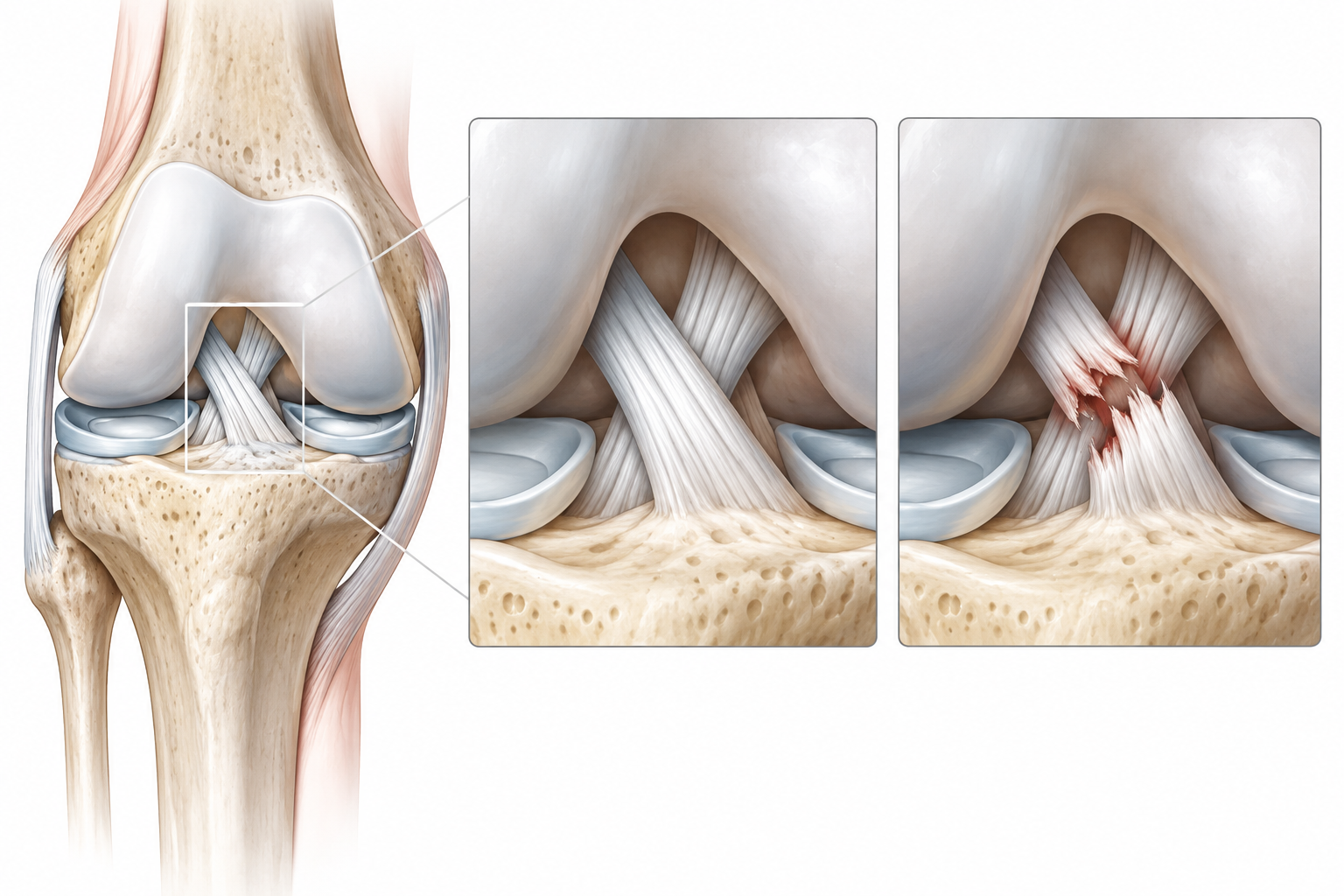
ACL anatomy and injury
The ACL crosses the center of the knee and contributes to forward and rotational stability. This illustration compares an intact ligament with a complete tear.
What Are the Symptoms of an ACL Tear?
At the Time of Injury, Patients May Experience:
- A popping sensation
- Sudden knee pain
- Rapid swelling
- Difficulty continuing activity
- Reduced knee movement
After the Initial Injury Settles, Some Patients Develop:
- A feeling that the knee gives way
- Instability during pivoting
- Difficulty returning to sport
- Reduced confidence in the knee
- Recurrent swelling
- Symptoms from associated meniscus or cartilage injuries
Not every patient experiences the same degree of instability.
How Is an ACL Tear Diagnosed?
Diagnosis combines the history of injury with clinical examination and appropriate imaging.
The examination may include:
- Lachman test
- Anterior drawer assessment
- Pivot-shift assessment when appropriate
- Collateral ligament examination
- Meniscus assessment
- Range of motion
- Swelling
- Strength
- Overall limb alignment
MRI is useful for assessing the ACL and identifying associated injuries.
However, MRI should not be interpreted in isolation.
A structural ACL tear on MRI does not by itself determine whether reconstruction is necessary.
What Does Knee Laxity Mean?
After an ACL injury, the injured knee may demonstrate increased movement compared with the opposite side.
This can be evaluated clinically and, in selected circumstances, with objective laxity measurement devices.
Instrumented testing can provide additional information about side-to-side anterior translation.
However, treatment decisions should not be based on one numerical measurement alone.
The patient's symptoms, rotational stability, activity requirements, associated injuries and functional performance remain important.
Does Every ACL Tear Need Surgery?
No.
Some patients can achieve satisfactory function with structured rehabilitation without ACL reconstruction.
Nonsurgical management may be particularly reasonable when the patient:
- Does not participate in high-demand pivoting activities
- Does not experience recurrent giving-way episodes
- Achieves acceptable functional stability
- Responds well to rehabilitation
- Is comfortable modifying certain activities if necessary
Other patients continue to experience instability despite appropriate rehabilitation.
For these patients, surgical reconstruction may become more relevant.
When Is ACL Surgery Considered?
ACL reconstruction may be considered when instability interferes with desired activities or exposes the knee to recurrent giving-way episodes.
Factors can include:
- Recurrent functional instability
- Desire to return to pivoting or cutting sports
- High-demand occupation
- Associated repairable meniscus injury
- Combined ligament injury
- Persistent instability despite rehabilitation
- Individual patient goals
The decision should be individualized rather than based on age, MRI appearance or sport participation alone.
Why Is Physiotherapy Important Before Surgery?
When appropriate, rehabilitation before ACL reconstruction can help restore:
- Knee extension
- Knee flexion
- Swelling control
- Quadriceps activation
- Strength
- Walking pattern
Operating on a significantly swollen and stiff knee can complicate postoperative recovery.
The objective is therefore not simply to schedule reconstruction as quickly as possible, but to prepare the knee appropriately unless another injury requires more urgent treatment.
What Is ACL Reconstruction?
ACL reconstruction replaces the function of the damaged ligament using graft tissue.
The graft is positioned through bone tunnels in the femur and tibia and fixed to allow biological incorporation.
Successful reconstruction requires attention to more than graft placement alone.
Important considerations include:
- Appropriate indication
- Anatomical tunnel positioning
- Graft choice
- Fixation
- Associated meniscus injury
- Other ligament injuries
- Limb alignment when relevant
- Rehabilitation
What Grafts Can Be Used?
Common graft options include:
- Hamstring tendon autograft
- Patellar tendon autograft
- Quadriceps tendon autograft
- Selected allograft tissue
Each graft has potential advantages and disadvantages.
There is no single graft that is automatically best for every patient.
Selection Should Consider:
- Age
- Sport
- Activity level
- Occupation
- Previous surgery
- Anatomy
- Associated procedures
- Patient priorities
- Surgeon experience
Can a Torn ACL Be Repaired Instead of Reconstructed?
Selected ACL tears may have characteristics that make primary ACL repair worth considering.
Potential factors include:
- Tear location
- Tissue quality
- Time from injury
- Ability to mobilize the ligament
- Patient characteristics
- Associated injuries
Primary repair is not appropriate for every ACL tear.
Many tears are better treated with reconstruction when surgery is indicated.
The decision should therefore be based on the actual tear pattern and tissue quality rather than simply the patient's age or desire for a smaller procedure.
What If the Meniscus Is Also Torn?
Meniscus injuries commonly occur together with ACL tears.
The meniscus contributes to:
- Load distribution
- Shock absorption
- Joint stability
- Protection of articular cartilage
Whenever clinically appropriate, preservation of repairable meniscal tissue is desirable.
ACL reconstruction and meniscus repair may therefore be performed during the same operation in selected patients.
Meniscal treatment can also influence postoperative rehabilitation.
What Is a Bucket-Handle Meniscus Tear with an ACL Injury?
A bucket-handle tear is a displaced longitudinal meniscus tear.
The displaced fragment can move toward the center of the knee and may prevent full extension, producing a mechanically locked knee.
This situation may require more urgent assessment than an isolated ACL tear because the displaced meniscus can influence timing and treatment priorities.
What Happens During ACL Surgery?
The exact procedure depends on the injury pattern.
Arthroscopy allows assessment of structures inside the knee, including:
- ACL
- Menisci
- Articular cartilage
- Other intra-articular structures
Associated injuries can be treated when appropriate.
For ACL reconstruction, the selected graft is prepared and positioned to reproduce ACL function as accurately as reasonably possible.
The graft is then secured using an appropriate fixation strategy.
What Happens After ACL Reconstruction?
Rehabilitation is a major component of treatment.
Early Objectives Commonly Include:
- Swelling control
- Restoration of knee extension
- Progressive knee flexion
- Quadriceps activation
- Safe walking
Later Rehabilitation Progresses Toward:
- Strength
- Balance
- Neuromuscular control
- Running
- Jumping
- Change-of-direction activities
- Sport-specific training
The exact program depends on associated procedures and individual progress.
When Can I Return to Sport?
Return to sport should not be based on time alone.
Assessment may include:
- Full or appropriate range of motion
- Knee stability
- Strength
- Limb symmetry
- Hop testing
- Movement quality
- Sport-specific performance
- Psychological readiness
Biological graft maturation also requires time.
Returning too early simply because the knee feels better may expose the reconstruction to unnecessary risk.
Return to sport should therefore be treated as a structured decision rather than a calendar date.
Meeting these criteria supports an individualized return-to-sport decision; it does not guarantee return to a particular sport or level.
Can an ACL Graft Fail?
Yes.
ACL reconstruction can fail because of several possible factors, including:
- New trauma
- Technical factors
- Tunnel position
- Biological failure
- Associated instability
- Unrecognized ligament injury
- Meniscus deficiency
- Alignment issues in selected cases
- Infection in uncommon cases
When reconstruction fails, the cause should be investigated before another ACL operation is planned.
What Is Revision ACL Reconstruction?
Revision ACL reconstruction is surgery performed after failure of a previous ACL reconstruction.
Revision surgery is often more complex than primary reconstruction.
Evaluation may include:
- Previous tunnel position
- Tunnel size
- Existing fixation devices
- Bone loss
- Graft status
- Meniscus condition
- Cartilage condition
- Associated ligament stability
- Limb alignment
- Evidence of infection when relevant
Some patients can undergo revision in one operation.
Others may require staged treatment, particularly when previous tunnels are significantly enlarged, poorly positioned or when infection is suspected.
When Should You See an ACL or Sports-Knee Specialist?
Specialist assessment may be appropriate when the knee repeatedly gives way, when instability affects desired activities, or when an ACL injury is associated with a meniscus, cartilage or other ligament injury.
The decision about treatment should be based on examination, knee stability, activity requirements, response to rehabilitation and individual goals rather than MRI findings alone.
Does a Complete ACL Tear Always Require Surgery?
No. Treatment depends on functional instability, activity requirements, associated injuries and response to rehabilitation.
Can I Walk with a Torn ACL?
Many patients regain ordinary walking after the acute injury settles. The more important problem for some patients is instability during pivoting or higher-demand activities.
Can I Go to the Gym with an ACL Tear?
Appropriate exercise is often part of rehabilitation, but the program should reflect the stage of injury, knee stability and associated injuries.
Do I Need MRI for an ACL Injury?
MRI is useful for confirming structural injury and assessing associated meniscus, cartilage and ligament damage, but treatment should still be based on the complete clinical assessment.
How Soon After Injury Should ACL Surgery Be Done?
There is no universal date for every patient. Knee swelling, range of motion, associated injuries and treatment priorities should be considered.
Is ACL Repair Better Than ACL Reconstruction?
Neither is universally better. Repair is suitable only for selected tear patterns and tissue characteristics. Reconstruction remains appropriate for many ACL tears requiring surgery.
Which ACL Graft Is Best?
There is no universally best graft. Selection depends on the individual patient, sport, anatomy, previous surgery and treatment priorities.
Can I Return to Football After ACL Reconstruction?
Many patients aim to return to pivoting sports after reconstruction and rehabilitation. Return should depend on functional recovery and appropriate testing rather than time alone.
When should I see an ACL or sports-knee specialist?
Specialist assessment may be appropriate when the knee repeatedly gives way, instability affects desired activities, or an ACL injury is associated with a meniscus, cartilage or other ligament injury. Treatment decisions should follow clinical assessment and rehabilitation considerations.
Written and medically reviewed by: Dr. Yousef Abuodeh Consultant Orthopedic Surgeon Last medically reviewed: September 2, 2026