
What Is the Meniscus?
Each knee contains two menisci:
- Medial meniscus
- Lateral meniscus
These structures sit between the femur and tibia.
The Menisci Contribute To:
- Distribution of load across the knee
- Shock absorption
- Joint stability
- Joint congruity
- Protection of articular cartilage
The meniscus should therefore not be regarded as unnecessary tissue that can simply be removed whenever it tears.
Meniscus anatomy and tear patterns
Meniscus tears vary in orientation, location and tissue displacement. The tear pattern is considered together with symptoms, tissue quality, stability and the condition of the whole knee.
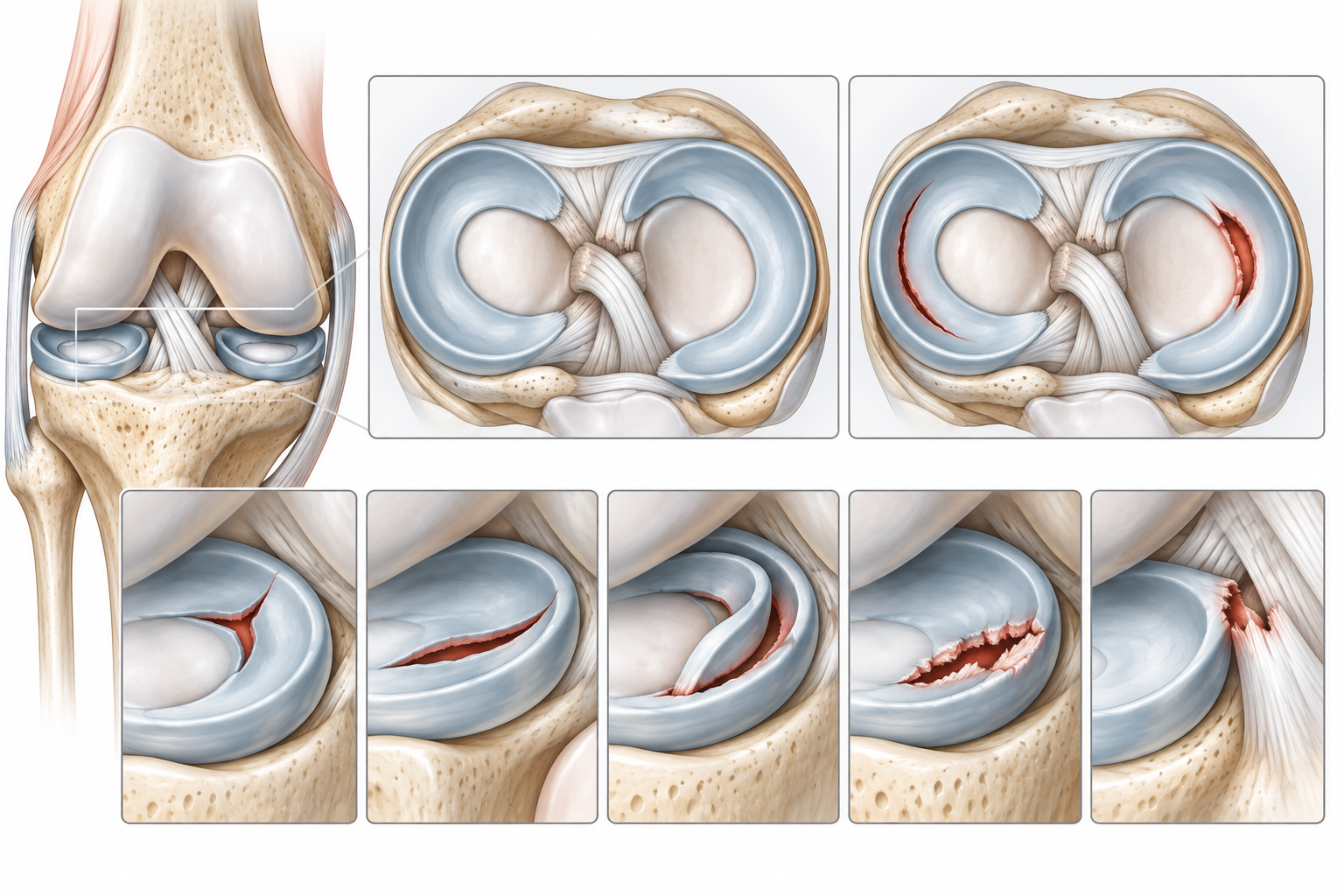
How Does a Meniscus Tear Occur?
Meniscus tears can occur in different ways.
In younger or athletic patients, tears may occur during:
- Twisting
- Pivoting
- Sudden direction change
- Deep flexion under load
- Sports injuries
Meniscus injuries may also occur together with an ACL tear.
In other patients, degenerative changes can gradually weaken the meniscal tissue and produce a tear without a major traumatic event.
What Are the Symptoms of a Meniscus Tear?
Symptoms can include:
- Joint-line pain
- Swelling
- Pain during twisting
- Pain with deep knee flexion
- Clicking or catching
- Reduced range of motion
- Mechanical locking
- Difficulty with sport or activity
However, symptoms are not always specific.
A meniscus tear seen on MRI does not automatically prove that it is the cause of the patient's knee pain.
How Is a Meniscus Tear Diagnosed?
Assessment includes:
- History of injury
- Location and character of pain
- Presence of swelling
- Mechanical symptoms
- Range of motion
- Joint-line tenderness
- Meniscus examination
- Ligament stability
X-rays may be appropriate to evaluate the overall knee and identify arthritis or other bony abnormalities.
MRI can provide useful information about the menisci, cartilage, ligaments and other structures.
Imaging findings should always be interpreted in the context of the patient's symptoms and examination.
Does Every Meniscus Tear Need Surgery?
No.
Many meniscus tears can initially be managed without surgery.
Nonsurgical treatment may include:
- Activity modification
- Physiotherapy
- Strengthening
- Appropriate medication
- Gradual return to activity
The Appropriate Treatment Depends On:
- Patient age
- Tear pattern
- Tear location
- Tissue quality
- Symptoms
- Presence of locking
- Associated ACL injury
- Degree of arthritis
- Activity requirements
An MRI report alone should not determine whether arthroscopy is necessary.
An MRI-detected meniscus tear alone is not an indication for arthroscopy.
What Is Meniscus Repair?
Meniscus repair aims to preserve the torn meniscal tissue and allow biological healing.
Different repair techniques may be used depending on the tear pattern and location.
These can include arthroscopic suture-based repair techniques.
The objective is to restore continuity of useful meniscal tissue rather than remove it.
Which Meniscus Tears Can Be Repaired?
Not every meniscus tear has the same healing potential.
Repairability depends on factors including:
- Tear pattern
- Tear location
- Blood supply
- Tissue quality
- Tear chronicity
- Patient age and biological factors
- Associated ACL injury
- Ability to reduce the tear anatomically
The final decision about repairability may sometimes become clearer during arthroscopic assessment.
Why Preserve the Meniscus?
The meniscus plays an important mechanical role in the knee.
Removing meniscal tissue reduces the amount of tissue available to distribute joint load.
For this reason, when surgery is required, the general objective should be:
Preserve as much functional meniscus as reasonably possible.
This does not mean that every tear should be repaired.
Some tears are biologically or mechanically unsuitable for successful repair.
What Is Partial Meniscectomy?
Partial meniscectomy involves removing an unstable or irreparable portion of the meniscus while preserving as much healthy functional tissue as possible.
It may be appropriate for selected tears that cannot reasonably be repaired.
The objective should not be routine removal of the entire meniscus.
Meniscus Repair vs Partial Meniscectomy
Meniscus Repair
Attempts to preserve and heal the torn tissue.
Potential advantages include preservation of meniscal function.
However, healing takes time and rehabilitation may need to protect the repair.
Partial Meniscectomy
Removes the unstable irreparable portion of the tear.
Recovery from the procedure itself may be quicker in some patients, but meniscal tissue is permanently lost.
The appropriate choice depends on the actual tear rather than simply which operation has the shortest early recovery.
What Is a Bucket-Handle Meniscus Tear?
A bucket-handle tear is a longitudinal tear in which a substantial portion of the meniscus becomes displaced toward the center of the knee.
It can cause:
- Sudden pain
- Mechanical catching
- Loss of knee extension
- A locked knee
A genuinely locked knee following an acute injury requires timely orthopedic assessment.
When the tissue is suitable, reduction and repair of a displaced bucket-handle tear may be considered.
What Does a “Locked Knee” Mean?
A true mechanically locked knee has an intra-articular mechanical block that prevents full motion, particularly extension.
A displaced meniscus tear is one possible cause.
This should be distinguished from a knee that is difficult to move because of pain, swelling, guarding or muscle spasm.
A genuinely locked knee after injury warrants timely orthopedic assessment, but not every painful knee or meniscus tear is an emergency.
Meniscus Tear with ACL Injury
Meniscus tears frequently accompany ACL injuries.
The ACL-deficient knee may also expose certain meniscal structures to abnormal stresses.
When ACL reconstruction is indicated and the meniscus is repairable, both injuries may be addressed during the same operation.
The presence of a meniscus repair can influence postoperative rehabilitation.
What Is a Meniscus Root Tear?
The meniscus roots anchor the meniscus to the tibia.
A root tear can significantly impair normal meniscal function.
Treatment depends on:
- Tear type
- Degree of arthritis
- Limb alignment
- Cartilage condition
- Patient age
- Activity
- Tissue quality
Selected root tears may be considered for repair.
Advanced arthritis can significantly change the appropriate treatment strategy.
What Are Degenerative Meniscus Tears?
Degenerative meniscus tears commonly occur in knees that already demonstrate age-related or arthritic changes.
In this situation, the tear seen on MRI may be only one part of a broader degenerative joint process.
Arthroscopic surgery is therefore not automatically appropriate simply because MRI identifies a meniscus tear.
The clinician should determine whether symptoms are more likely to originate from the meniscus, osteoarthritis or another structure.
What Happens During Meniscus Surgery?
Arthroscopy allows the surgeon to inspect the inside of the knee.
Assessment can include:
- Medial meniscus
- Lateral meniscus
- Articular cartilage
- ACL
- Other intra-articular structures
The Tear Is Assessed For:
- Pattern
- Location
- Stability
- Tissue quality
- Reducibility
- Repair potential
The surgeon can then determine whether repair, limited resection or another treatment is appropriate.
What Happens After Meniscus Repair?
Rehabilitation after repair depends on the tear and repair technique.
The program may involve temporary modifications to:
- Weight bearing
- Knee flexion
- Brace use
- Strengthening
- Sporting activity
This is because the repaired tissue requires biological healing.
A rehabilitation program should therefore reflect the actual procedure performed rather than follow one identical protocol for every meniscus repair.
How Long Does a Meniscus Repair Take to Heal?
Meniscal healing is biological and takes time.
Symptoms may improve before the tissue has completed healing.
Return to higher-demand activity should therefore consider:
- Tear pattern
- Repair technique
- Associated procedures
- Strength
- Range of motion
- Knee symptoms
- Functional recovery
Patients undergoing simultaneous ACL reconstruction may follow a different progression from patients undergoing isolated meniscus repair.
Can a Meniscus Repair Fail?
Yes.
Not every repaired meniscus heals successfully.
Factors influencing healing can include:
- Tear location
- Tissue quality
- Tear pattern
- Chronicity
- Biological environment
- Associated injuries
- Rehabilitation
- Further trauma
Persistent or recurrent symptoms after repair require appropriate reassessment.
When Should You See a Meniscus Specialist?
Specialist assessment may be appropriate when knee pain, swelling, catching, locking or activity limitation persists, particularly after an injury or when an associated ACL injury is suspected.
The appropriate treatment depends on symptoms, examination, tear pattern and location, tissue quality, arthritis, associated injuries and activity requirements.
Can a Meniscus Tear Heal Without Surgery?
Some tears can become asymptomatic or be successfully managed without surgery. Healing potential varies according to tear location, pattern and biological factors.
Does an MRI-Proven Meniscus Tear Need Arthroscopy?
No. MRI findings must be correlated with symptoms, examination, arthritis and tear characteristics.
Is Meniscus Repair Better Than Removal?
Preserving repairable functional meniscus is desirable, but not every tear can or should be repaired.
How Do I Know If My Knee Is Really Locked?
A mechanically locked knee has a physical block preventing full motion, particularly extension. Pain and swelling can also limit motion without true mechanical locking.
Can a Bucket-Handle Tear Be Repaired?
Many can be considered for repair depending on tissue quality, tear characteristics, chronicity and other patient factors.
Can Meniscus and ACL Surgery Be Done Together?
Yes. When both require surgical treatment, ACL reconstruction and meniscus repair can be performed during the same operation in selected patients.
When Can I Return to Sport After Meniscus Repair?
Timing depends on the tear, repair, associated procedures and functional recovery. Return should be individualized rather than based only on a predetermined date.
Written and medically reviewed by: Dr. Yousef Abuodeh Consultant Orthopedic Surgeon Last medically reviewed: September 2, 2026