
What Is a Meniscus Root?
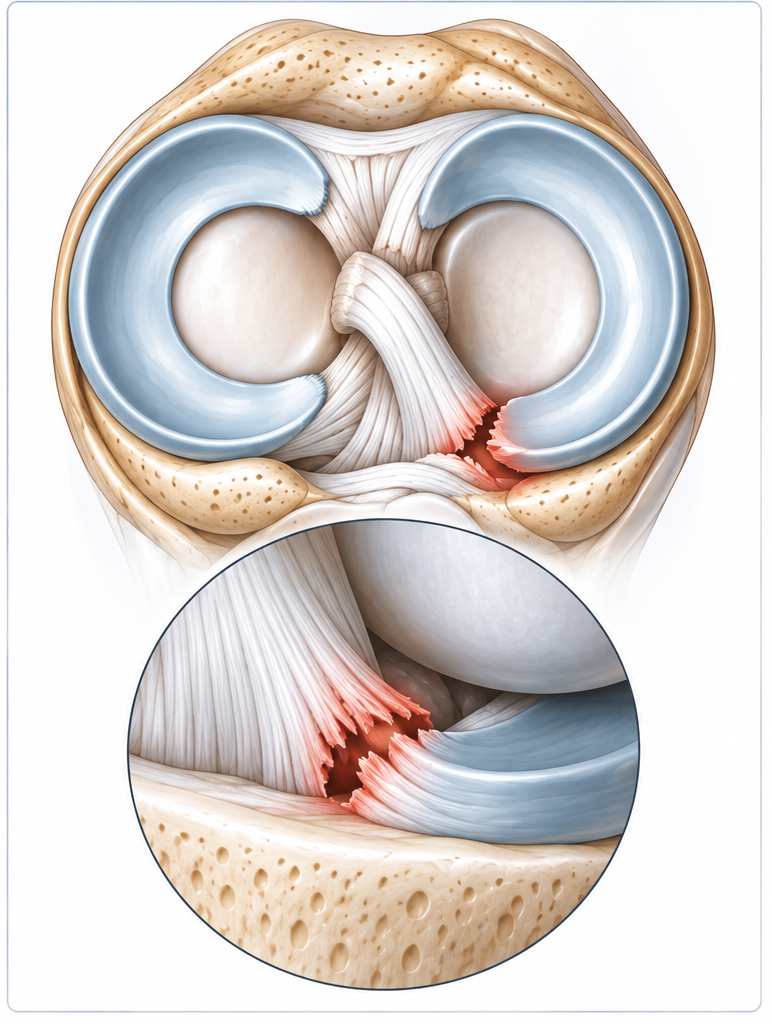
Each meniscus attaches to the tibia through anterior and posterior roots.
These attachments help maintain the position of the meniscus while the knee carries load.
The posterior root of the medial meniscus is particularly relevant clinically because tears in this region can significantly alter knee mechanics.
What Is a Meniscus Root Tear?
A root tear involves disruption of the meniscus at or near its attachment to bone.
This can reduce the meniscus's ability to maintain normal hoop stresses and distribute joint load.
The mechanical consequences can therefore be more important than the small physical size of the tear might suggest.
What a meniscus root tear affects
A root tear disrupts the attachment that helps the meniscus remain positioned while it distributes load. The magnified view highlights the damaged root region.
Who Gets Meniscus Root Tears?
Root tears can occur in different clinical settings.
Some occur during acute sporting injuries.
Others, particularly medial meniscus posterior root tears, may occur in middle-aged or older adults with degenerative changes.
The appropriate treatment can differ considerably between these groups.
What Are the Symptoms?
Symptoms can include:
- Pain along the joint line
- Posterior or medial knee pain
- Pain during weight bearing
- Swelling
- Pain with deep flexion
- Difficulty walking
- Sudden pain after a relatively minor event in some degenerative tears
Symptoms are not specific enough to diagnose a root tear without further assessment.
How Is a Root Tear Diagnosed?
Evaluation includes:
- History
- Examination
- Knee alignment
- Range of motion
- Joint-line tenderness
- Ligament stability
Weight-bearing X-rays are important for assessing arthritis and alignment.
MRI is useful for evaluating the meniscus root and associated cartilage.
Why Are Weight-Bearing X-Rays Important If I Already Have an MRI?
MRI can demonstrate the tear.
However, the decision about treatment also depends on the condition of the knee as a whole.
Weight-bearing X-rays help assess:
- Joint-space narrowing
- Osteoarthritis
- Limb alignment
- Other structural changes
Treating the MRI without evaluating the arthritic knee can lead to inappropriate recommendations.
What Is Meniscus Extrusion?
A damaged meniscus can become displaced outward beyond the edge of the tibial plateau.
This is known as meniscal extrusion.
Root dysfunction can contribute to extrusion and loss of effective meniscal load distribution.
Does Every Root Tear Need Repair?
No.
Repair may be considered in appropriately selected patients, but suitability depends on factors such as:
- Degree of arthritis
- Cartilage condition
- Alignment
- Meniscal extrusion
- Tissue quality and tear characteristics
- Symptoms
- Activity
- Ability to comply with rehabilitation
There is no universal age cutoff for root repair. Repairing a root in a severely arthritic knee may not address the dominant problem.
When Is Root Repair Considered?
Repair may be more appropriate when:
- The tear is repairable
- Articular cartilage remains reasonably preserved
- Advanced arthritis is absent
- Alignment is acceptable or can be addressed when necessary
- The patient's overall circumstances favor preservation
The objective is to restore the meniscal attachment and improve its mechanical function.
How Is a Meniscus Root Repaired?
Several techniques exist.
A common principle is to secure the torn root back near its anatomical attachment.
This may involve sutures passed through the meniscal tissue and fixation through a tibial tunnel or another repair construct.
The exact technique depends on the tear and surgeon's reconstruction strategy.
What If the Leg Is Significantly Bowed?
Varus alignment can increase loading through the medial compartment.
In selected patients with significant malalignment, alignment may influence whether isolated root repair is appropriate.
Occasionally an osteotomy or another strategy may need consideration.
This is not required for every patient with a root tear.
What If I Already Have Advanced Arthritis?
When advanced diffuse osteoarthritis is the dominant problem, root repair may be inappropriate or provide limited benefit.
Treatment should then focus on the arthritic joint rather than the MRI finding alone.
What Happens After Root Repair?
The repair needs time to heal biologically.
Rehabilitation may therefore include temporary restrictions on:
- Weight bearing
- Knee flexion
- Deep squatting
- Higher-load activity
Progression depends on the repair and individual patient.
Is Recovery the Same as After Partial Meniscectomy?
No.
Meniscus repair generally requires more protection because the objective is biological healing of repaired tissue.
The early recovery may therefore be slower than after limited meniscectomy.
The procedures have different goals.
What Happens If the Root Is Not Repaired?
The natural history varies.
Loss of root function can increase compartment loading and may contribute to progression of degenerative changes in susceptible knees.
However, this does not mean that every MRI-detected root tear should be surgically repaired, and root repair does not guarantee prevention of future osteoarthritis.
Is a Root Tear More Serious Than a Normal Meniscus Tear?
It can have important mechanical consequences because the meniscal attachment is disrupted.
Can a Root Tear Heal by Itself?
Healing potential depends on the tear and biological environment. Some symptomatic root tears considered for preservation require surgical repair.
Does Every Root Tear Need Surgery?
No.
Do I Need Weight-Bearing X-Rays?
They are important when evaluating arthritis and alignment, even when MRI is already available.
Can a Root Tear Cause Arthritis?
Loss of meniscal root function can alter load distribution and contribute to degenerative progression.
Can a Root Tear Be Repaired If I Have Arthritis?
The degree of arthritis matters. Advanced structural arthritis can make repair less appropriate.
Written and medically reviewed by: Dr. Yousef Abuodeh Consultant Orthopedic Surgeon Last medically reviewed: September 2, 2026