
What Is Knee Arthritis?
The knee is formed by the femur, tibia and patella.
The surfaces of these bones are covered by articular cartilage, which allows relatively smooth movement and distributes load across the joint.
Arthritis occurs when the joint undergoes progressive structural deterioration.
Osteoarthritis is the most common form and involves changes affecting cartilage, underlying bone and other structures within the joint.
What Does “Wear and Tear” Mean?
Osteoarthritis is often described as simple “wear and tear,” but this is an incomplete explanation.
It is a biological and mechanical disease involving the whole joint.
Changes may include:
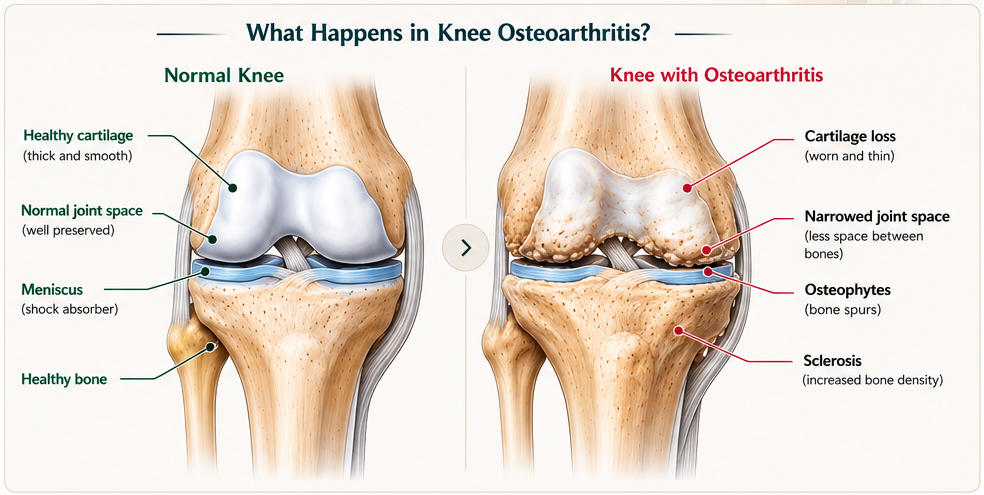
- Cartilage loss
- Bone remodeling
- Osteophyte formation
- Joint-space narrowing
- Synovial inflammation
- Meniscus degeneration
- Progressive deformity
Different patients can therefore experience arthritis differently.
What Are the Symptoms of Knee Arthritis?
Symptoms may include:
- Knee pain during walking
- Pain when climbing or descending stairs
- Difficulty standing from a chair
- Stiffness
- Swelling
- Reduced walking distance
- Grinding or crepitus
- Progressive bow-leg or knock-knee deformity
- Reduced range of motion
- Night pain in more advanced disease
Symptoms can fluctuate.
A period of increased pain does not necessarily mean that the arthritis has suddenly progressed.
Where Is Arthritic Knee Pain Felt?
Pain may occur:
- On the inner side of the knee
- On the outer side
- At the front of the knee
- Behind the knee
- More diffusely throughout the joint
The location depends partly on which areas of the knee are affected.
Other conditions can produce similar symptoms, so pain location alone does not establish the diagnosis.
Why Do Some People Have Severe X-Ray Arthritis but Less Pain?
Pain is influenced by more than cartilage loss.
Factors can include:
- Inflammation
- Bone changes
- Muscle strength
- Joint mechanics
- Activity
- Other pain sources
For this reason, treatment should not be recommended solely because an X-ray looks severe.
How Is Knee Arthritis Diagnosed?
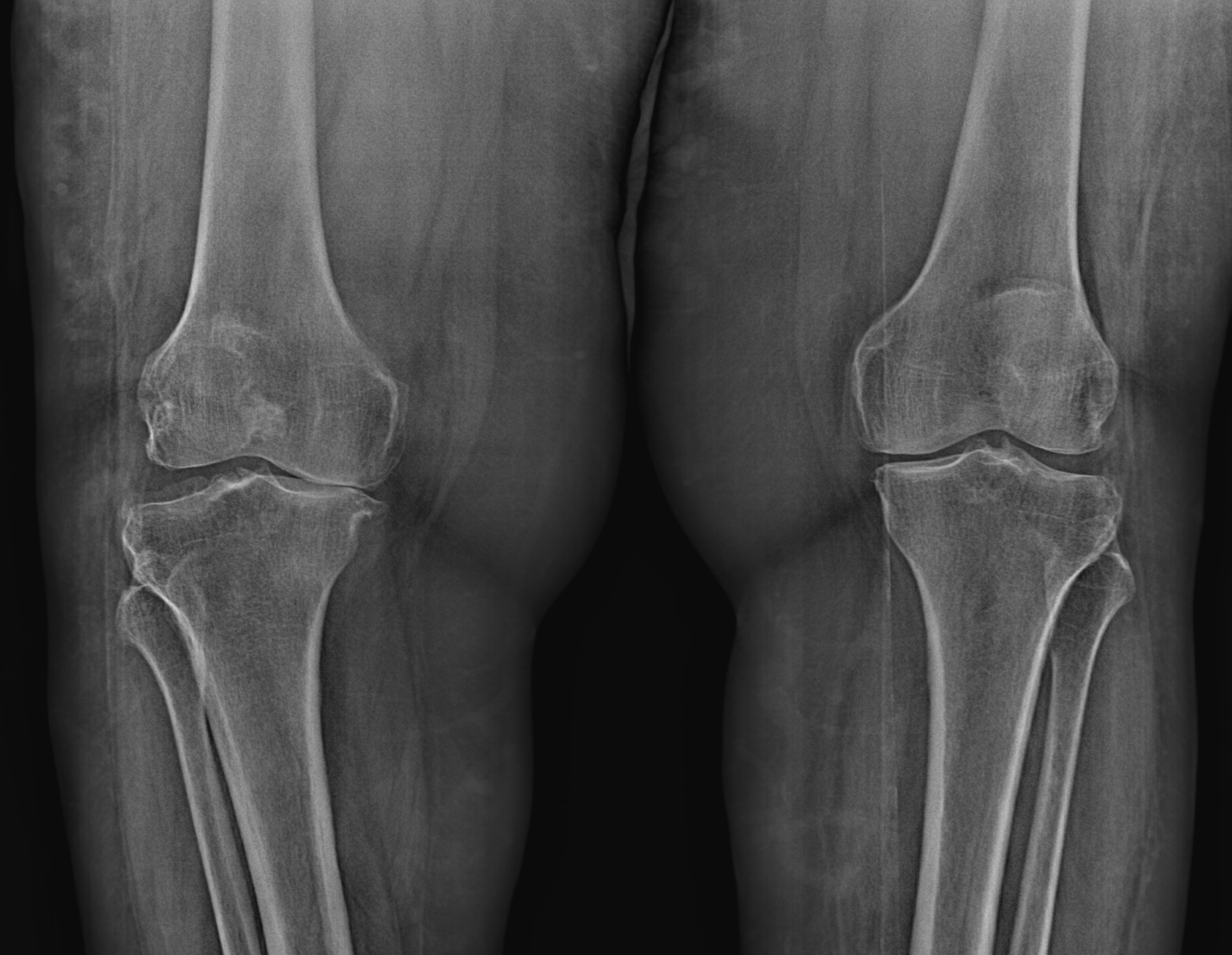
Educational example radiographs. The images alone do not determine treatment or provide individualized medical advice.
What Happens in Knee Osteoarthritis?
This illustration shows some of the structural changes that can develop as knee osteoarthritis progresses.
Assessment usually begins with:
- History
- Examination
- Walking pattern
- Knee alignment
- Range of motion
- Areas of tenderness
- Ligament stability
- Muscle strength
Weight-bearing X-rays are particularly useful because they demonstrate the knee under load.
Do I Need an MRI?
Not necessarily.
When symptoms, examination and weight-bearing X-rays clearly demonstrate advanced osteoarthritis, MRI often does not add information that changes treatment.
MRI may be useful when:
- The diagnosis is uncertain
- Symptoms do not match the X-ray
- Another condition is suspected
- Additional soft-tissue information is required
More imaging is not automatically better imaging.
What Are the Nonsurgical Treatment Options?
Treatment may include several strategies.
Activity Modification
Activities that consistently aggravate symptoms can sometimes be adjusted without abandoning physical activity completely.
Physiotherapy
Exercise can help maintain:
- Strength
- Movement
- Balance
- Function
Weight Management
For appropriate patients, reducing excess body weight can decrease mechanical load on the knee and improve general health.
Medication
Analgesic or anti-inflammatory medication may provide symptom relief when medically appropriate.
Medication should take the patient's other medical conditions into consideration.
Walking Aids
A cane or other walking aid can improve stability and reduce load in selected patients.
Strong muscles around the knee can improve functional capacity even though physiotherapy does not regrow severely damaged cartilage.
Do Knee Injections Help?
Several types of intra-articular treatment are used for symptomatic knee arthritis.
Depending on the individual patient, options may include corticosteroid or hyaluronic-acid injections.
The degree and duration of symptom improvement vary.
An injection may help symptoms, but it does not restore severely lost cartilage or reverse advanced structural arthritis.
Can Cartilage Be Regenerated?
Claims that an injection or supplement can reliably regenerate an extensively arthritic knee should be approached cautiously.
Cartilage-restoration procedures have roles in selected focal cartilage defects.
They are different from treatment of widespread advanced osteoarthritis affecting a substantial part of the knee.
When Is Knee Replacement Considered?
Knee replacement may be considered when there is a combination of:
- Advanced structural arthritis
- Persistent pain
- Significant functional limitation
- Difficulty walking or performing everyday activities
- Inadequate benefit from appropriate nonsurgical treatment
- A patient who understands the expected benefits, limitations and risks of surgery
There is no single X-ray threshold or pain score that determines the decision.
Am I Too Young for Knee Replacement?
Age alone does not determine whether surgery is appropriate.
For younger patients, additional consideration is given to:
- Expected lifetime activity
- Implant longevity
- Possibility of future revision
- Alternative treatment options
The objective is to balance current disability against the long-term implications of joint replacement.
Am I Too Old for Knee Replacement?
Chronological age alone is also not an absolute contraindication.
General health, medical risk, mobility, expected benefit and patient goals are more important.
What If Only One Part of My Knee Is Arthritic?
Some patients have arthritis predominantly affecting one compartment.
Depending on:
- Location of disease
- Ligament condition
- Deformity
- Symptoms
- Age and activity
different treatment strategies may be considered.
Not every arthritic knee requires the same operation.
What If My Knee Has Become Bowed?
Progressive varus or valgus deformity can accompany advanced arthritis.
Alignment is evaluated as part of treatment planning.
Severe deformity can influence the complexity of knee replacement and the required soft-tissue and implant strategy.
Does Knee Arthritis Always Get Worse?
Osteoarthritis can progress over time, but the rate varies considerably between patients.
Does Bone-on-Bone Arthritis Always Require Surgery?
No. Treatment depends on symptoms and function as well as imaging.
Can Physiotherapy Cure Arthritis?
Physiotherapy cannot restore severely lost cartilage, but it can improve strength, movement and function.
Should I Stop Exercising?
Usually not. Appropriate activity is generally preferable to unnecessary inactivity, although exercises may need modification.
Does a Meniscus Tear Cause Arthritis?
Meniscal damage and osteoarthritis can coexist and influence joint mechanics. A degenerative meniscus tear in an arthritic knee does not automatically require arthroscopy.
When Should I Consider Knee Replacement?
When symptoms and loss of function remain substantial despite appropriate nonsurgical treatment and the expected benefit of replacement justifies the procedure.
Written and medically reviewed by: Dr. Yousef Abuodeh Consultant Orthopedic Surgeon Last medically reviewed: August 31, 2026