
Do I Need a Knee Replacement?
Not every patient with knee arthritis needs surgery.
The decision to proceed with knee replacement should be based on the patient’s symptoms, physical examination, imaging findings, general health, previous treatment and expected benefit from surgery.
Knee replacement may be considered when patients experience:
- Persistent knee pain
- Difficulty walking or climbing stairs
- Pain at rest or during the night
- Progressive stiffness
- Loss of knee movement
- Significant deformity
- Advanced arthritis on appropriate imaging
- Inadequate improvement with nonsurgical treatment
- Reduced quality of life or independence
The decision should not be based on an X-ray alone. Age alone is also not an indication or contraindication for knee replacement.
What Is Knee Arthritis?
Knee osteoarthritis is a degenerative condition in which the cartilage covering the joint surfaces progressively deteriorates.
As cartilage becomes damaged, the joint can become painful, stiff and increasingly deformed.
The condition may involve one or several compartments of the knee.
Symptoms and X-ray findings do not always progress at the same rate, which is why treatment decisions should be based on the complete clinical picture rather than imaging alone.
Symptoms of Advanced Knee Arthritis
Symptoms can include:
- Knee pain during walking
- Difficulty with stairs
- Reduced walking distance
- Knee stiffness
- Swelling
- Grinding or crepitus
- Progressive bow-legged or knock-kneed deformity
- Pain at rest
- Night pain
- Difficulty standing from a chair
- Reduced confidence in the knee
- Progressive limitation of daily activities
How Is Knee Arthritis Diagnosed?
Assessment begins with a detailed history and orthopedic examination.
The examination may evaluate:
- Walking pattern
- Limb alignment
- Range of motion
- Areas of tenderness
- Knee swelling
- Ligament stability
- Fixed deformity
- Muscle strength
- Hip function
- Neurological findings when relevant
Weight-bearing X-rays are particularly useful when evaluating knee arthritis because they demonstrate how the joint behaves under load. In patients with clear advanced osteoarthritis on appropriate X-rays, MRI is generally not required simply to confirm the diagnosis. MRI may still be appropriate when the diagnosis is uncertain or when another condition is suspected.
Can Knee Replacement Be Avoided?
Many patients can initially be treated without surgery.
Depending on the individual case, nonsurgical treatment may include:
Activity Modification
Adjusting activities that consistently aggravate symptoms while maintaining appropriate movement and exercise.
Physiotherapy
Physiotherapy can help improve strength, mobility and function.
Weight Management
For appropriate patients, reducing excess body weight can decrease mechanical load on the knee and improve general health.
Medication
Analgesic or anti-inflammatory medication may be considered according to the patient’s medical history.
Injections
Selected patients may benefit from intra-articular injections.
The degree and duration of improvement vary between patients.
Injections do not restore severely damaged cartilage or permanently reverse advanced osteoarthritis.
Walking Aids
A cane or other walking aid may improve safety and reduce symptoms in selected patients.
When symptoms remain acceptable with conservative treatment, there is usually no reason to proceed directly to joint replacement.
What Is Total Knee Replacement?
Total knee replacement is also known as:
- Total knee arthroplasty
- TKR
- TKA
During the procedure, the damaged surfaces of the knee are prepared and replaced with prosthetic components.
The operation does not literally remove the entire knee.
Instead, controlled amounts of damaged bone and cartilage are resurfaced and replaced by components designed to restore a functional joint surface.
The principal goals are to:
- Reduce pain
- Improve walking
- Improve useful knee motion
- Correct significant deformity
- Restore appropriate stability
- Improve function
- Improve quality of life
A knee replacement should not be expected to feel identical to a completely healthy natural knee.
Is Every Knee Replacement the Same?
No.
Successful knee replacement requires more than simply inserting standard components.
Important factors can include:
- Individual anatomy
- Degree and location of arthritis
- Limb alignment
- Bone quality
- Ligament condition
- Fixed deformity
- Knee stiffness
- Previous operations
- Bone loss
- Implant design
- Component size and position
- Soft-tissue balance
Surgical planning should therefore be individualized.
What Type of Knee Implant Will I Receive?
Patients frequently ask which knee implant is the “best.”
There is no single implant that is automatically best for every patient.
Selection may depend on:
- Patient anatomy
- Bone quality
- Ligament stability
- Degree of deformity
- Previous surgery
- Available implant sizes
- Level of constraint required
- Long-term clinical evidence
- Surgeon familiarity with the implant system
“Which brand will be used?” but: “Why is this implant and reconstruction appropriate for my knee?”
Robotic vs Conventional Knee Replacement
Robotic systems, navigation and digital planning technologies can assist surgeons with aspects of surgical planning and execution.
They may provide additional information relating to alignment, component positioning and intraoperative assessment.
However, technology does not operate independently and does not guarantee a successful result.
Outcome still depends on factors including:
- Correct patient selection
- Accurate diagnosis
- Surgical planning
- Surgeon judgment
- Soft-tissue management
- Implant selection
- Prevention of complications
- Rehabilitation
- Patient factors
Patients should therefore avoid choosing knee replacement solely because the word “robotic” is used. Technology should support good surgical decision-making rather than replace it.
What Happens Before Knee Replacement?
Preparation may include:
- Clinical assessment
- Appropriate weight-bearing X-rays
- Blood investigations
- Kidney or liver function tests when indicated
- Coagulation studies
- Medical evaluation
- Cardiac assessment when required
- Review of medications
- Management of anticoagulant therapy when appropriate
- Optimization of diabetes and other chronic medical conditions
- Evaluation for active infection
- Anesthesia assessment
- Surgical planning
Medical optimization is an important part of reducing avoidable perioperative risk.
What Happens During Knee Replacement?
During surgery, damaged joint surfaces are carefully prepared and prosthetic components are implanted.
The surgeon evaluates:
- Component size
- Component position
- Limb alignment
- Knee stability
- Ligament balance
- Range of motion
- Overall reconstruction
The exact surgical technique varies according to the patient’s anatomy, diagnosis and implant system.
What Happens After Surgery?
Modern recovery pathways encourage early mobilization when medically and surgically appropriate.
Postoperative care may include:
- Multimodal pain control
- Prevention of blood clots
- Early standing and walking
- Physiotherapy
- Range-of-motion exercises
- Strengthening
- Wound care
- Progressive activity
- Follow-up examinations
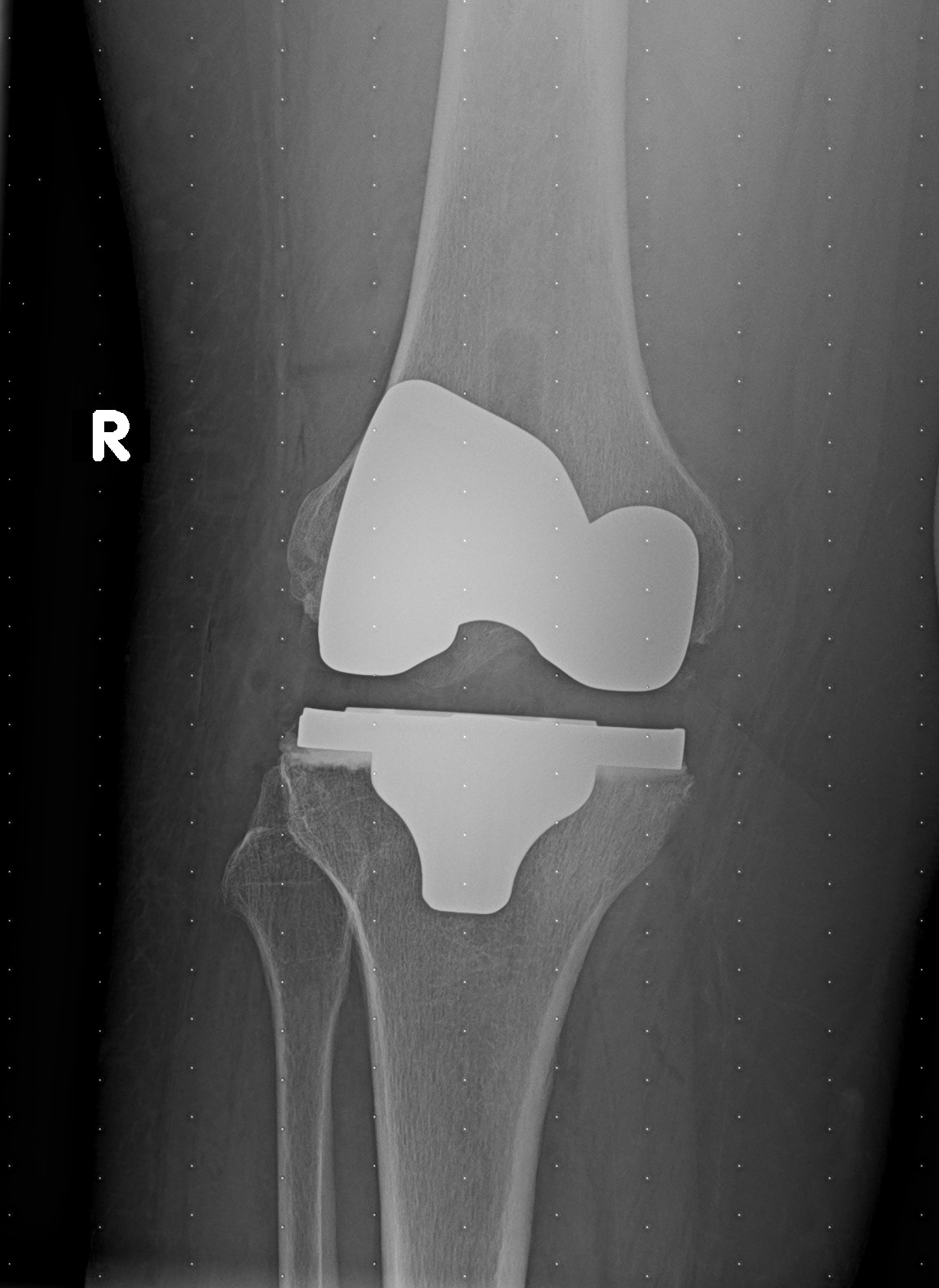
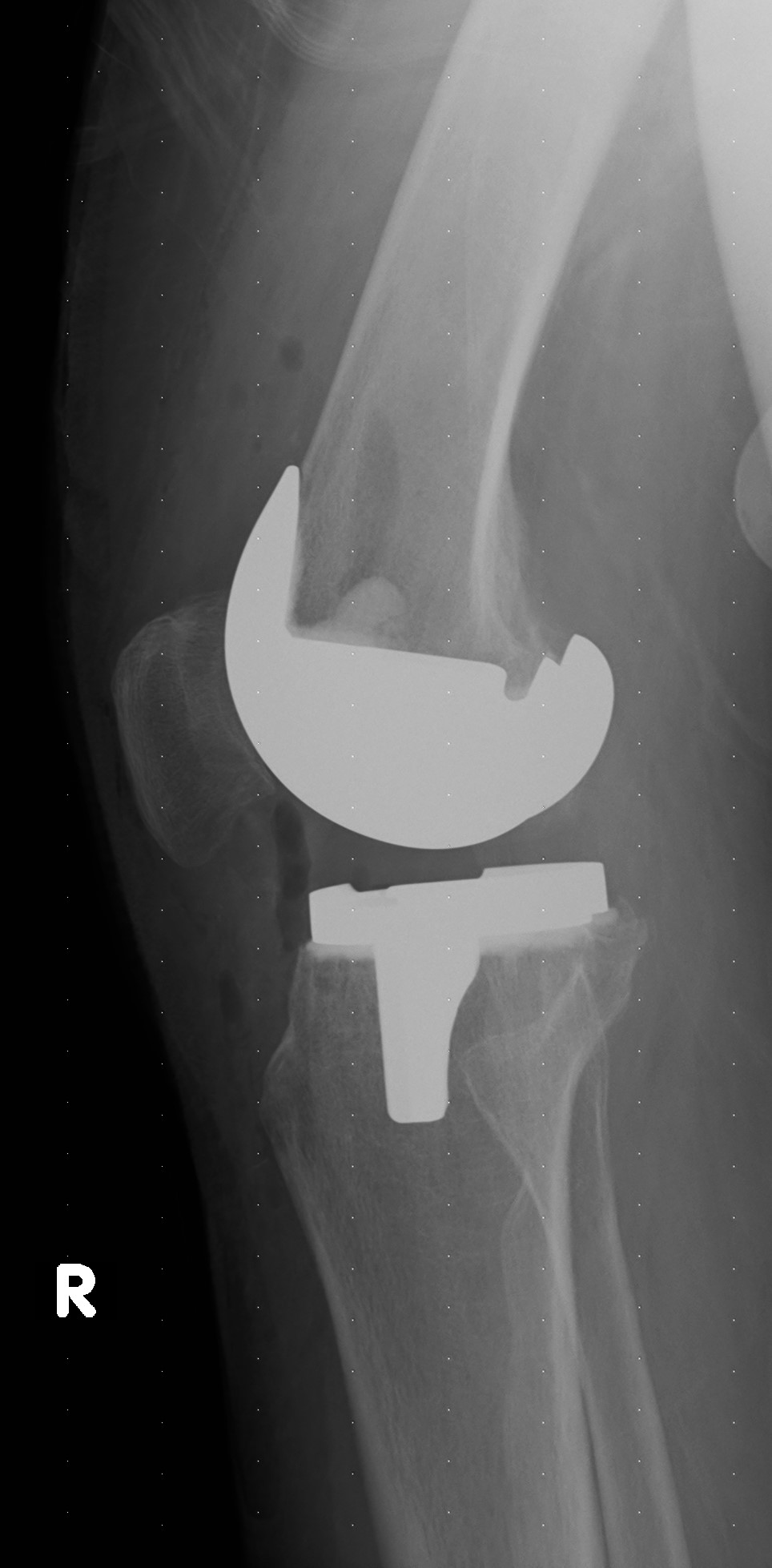
Educational example radiographs. The images alone do not determine treatment or provide individualized medical advice.
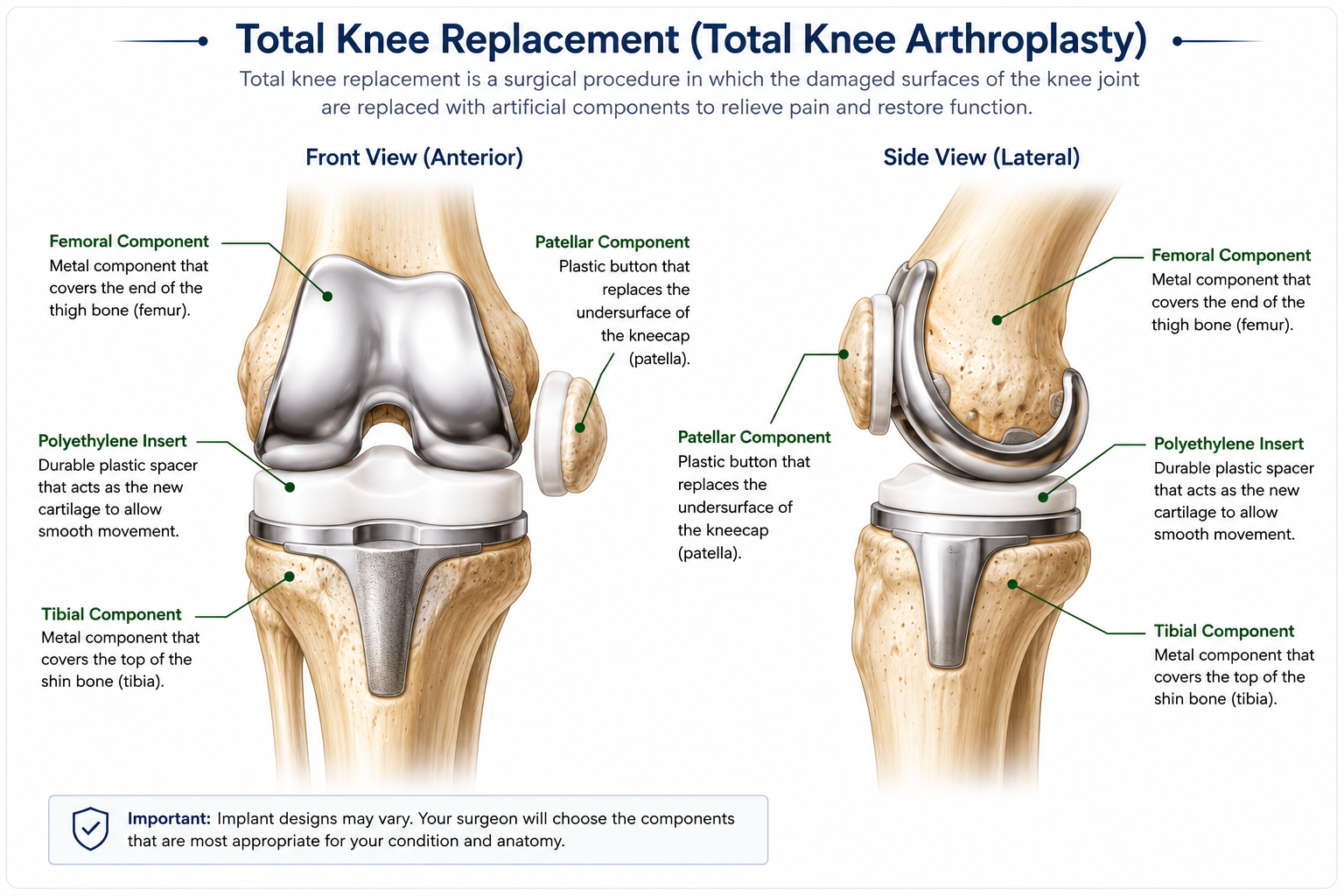
The illustration below explains the main components commonly used in a total knee replacement. Implant design and configuration may vary according to the individual case.
Understanding the Components of a Total Knee Replacement
A total knee replacement replaces the damaged joint surfaces with carefully positioned components designed to restore a stable, functional articulation. The exact implant design and surgical plan are selected according to the individual patient and clinical situation.
Recovery should be individualized rather than based on a rigid timetable.
How Long Does Recovery Take?
Recovery after knee replacement occurs gradually.
Some patients regain basic independence within the early postoperative period, while improvement in strength, mobility, endurance and confidence may continue for several months.
Recovery can be influenced by:
- Preoperative mobility
- Muscle strength
- Age
- General health
- Degree of deformity
- Preoperative stiffness
- Other musculoskeletal conditions
- Rehabilitation
- Development of complications
Early improvement should not be confused with complete recovery.
How Long Does a Knee Replacement Last?
Modern knee replacements are designed for long-term function, but no artificial joint can be guaranteed to last for life.
Longevity depends on multiple factors including:
- Implant design
- Fixation
- Component position
- Patient activity
- Body weight
- Bone quality
- Infection
- Trauma
- Biological factors
The possibility of revision surgery during the patient’s lifetime deserves particular consideration in younger patients.
Risks of Knee Replacement
Potential complications include:
- Infection
- Blood clots
- Bleeding
- Wound problems
- Knee stiffness
- Persistent pain
- Instability
- Fracture
- Nerve injury
- Blood-vessel injury
- Implant wear
- Implant loosening
- Medical or anesthetic complications
- Need for further surgery
Individual risk varies. The potential benefits and risks should be discussed as part of the informed-consent process.
What Is Revision Knee Replacement?
Revision knee replacement may be required when a previous knee replacement develops a significant problem.
Possible causes include:
- Infection
- Implant loosening
- Instability
- Stiffness
- Implant wear
- Periprosthetic fracture
- Bone loss
- Mechanical problems
Revision surgery can be considerably more complex than primary knee replacement. The first step is therefore to determine: Why is the knee replacement painful or failing? Only after identifying the cause should the appropriate treatment be planned. Learn About Revision Knee Replacement →
Why Consultation Matters
A consultation before considering knee replacement should answer three important questions:
1. What is actually causing the knee pain?
Not every painful knee is painful because of arthritis.
2. Are reasonable nonsurgical treatment options still available?
If symptoms remain manageable without surgery, continued conservative treatment may be appropriate.
3. Is this particular patient likely to benefit from knee replacement?
The presence of arthritis alone does not automatically answer this question.
The decision should combine diagnosis, symptoms, examination, imaging, general health, expectations and patient goals.
What Should You Consider When Choosing a Knee-Replacement Surgeon?
The decision should be based on the diagnosis, symptoms, examination, imaging findings, general health, previous treatment and expected benefit from surgery.
It is also important to discuss reasonable nonsurgical options, the proposed reconstruction, potential risks, rehabilitation and follow-up.
- Relevant orthopedic specialization
- Experience with the specific knee condition and procedure
- Experience with complex or revision cases when relevant
- Individualized implant and reconstruction planning
- A clear rehabilitation and follow-up plan
Knee Replacement Consultation in Amman, Jordan
If persistent knee pain is significantly affecting walking, sleep or quality of life, orthopedic assessment can help determine whether continued nonsurgical treatment or total knee replacement is more appropriate.
When available, bring previous X-rays, MRI studies, medical reports and a current medication list to your consultation.
Dr. Yousef Abuodeh
Consultant Orthopedic Surgeon
Amman, Jordan
Am I too young for knee replacement?
There is no single minimum age. Younger patients require careful consideration of diagnosis, symptoms, expected activity and the possibility of future revision surgery.
Am I too old for knee replacement?
Age alone is not an absolute contraindication. General health, surgical risk, functional limitation and expected benefit are more important.
Do I need an MRI before knee replacement?
Not routinely. In patients with clearly demonstrated advanced osteoarthritis on appropriate weight-bearing X-rays, MRI often adds little to the decision. It may be useful when the diagnosis is uncertain or another condition is suspected.
Can both knees be replaced at the same time?
Simultaneous bilateral knee replacement may be considered in selected patients, but it is a larger physiological procedure. Medical condition, age, surgical risk and rehabilitation needs should be carefully evaluated.
Can I kneel after knee replacement?
Some patients can kneel after recovery, while others find it uncomfortable or difficult. Individual experience varies.
Will my knee feel completely normal?
A successful knee replacement can provide substantial pain relief and improved function, but an artificial knee should not be expected to feel identical to a completely healthy natural knee.
When can I drive?
Return to driving depends on the operated side, strength, reaction time, medication use and individual recovery.
When can I travel after surgery?
Travel timing depends on wound healing, mobility, general health and individual blood-clot risk. Long-distance travel should be discussed with the treating surgeon.
What should I consider when choosing a knee-replacement surgeon?
Consider the surgeon’s relevant orthopedic specialization, experience with the specific condition and procedure, approach to individualized planning, discussion of nonsurgical alternatives and risks, and plan for rehabilitation and follow-up.
Written and medically reviewed by: Dr. Yousef Abuodeh Consultant Orthopedic Surgeon Last medically reviewed: August 31, 2026