
What Is Hip Arthritis?
The hip is a ball-and-socket joint.
The femoral head forms the ball, while the acetabulum forms the socket.
Both surfaces are covered by articular cartilage.
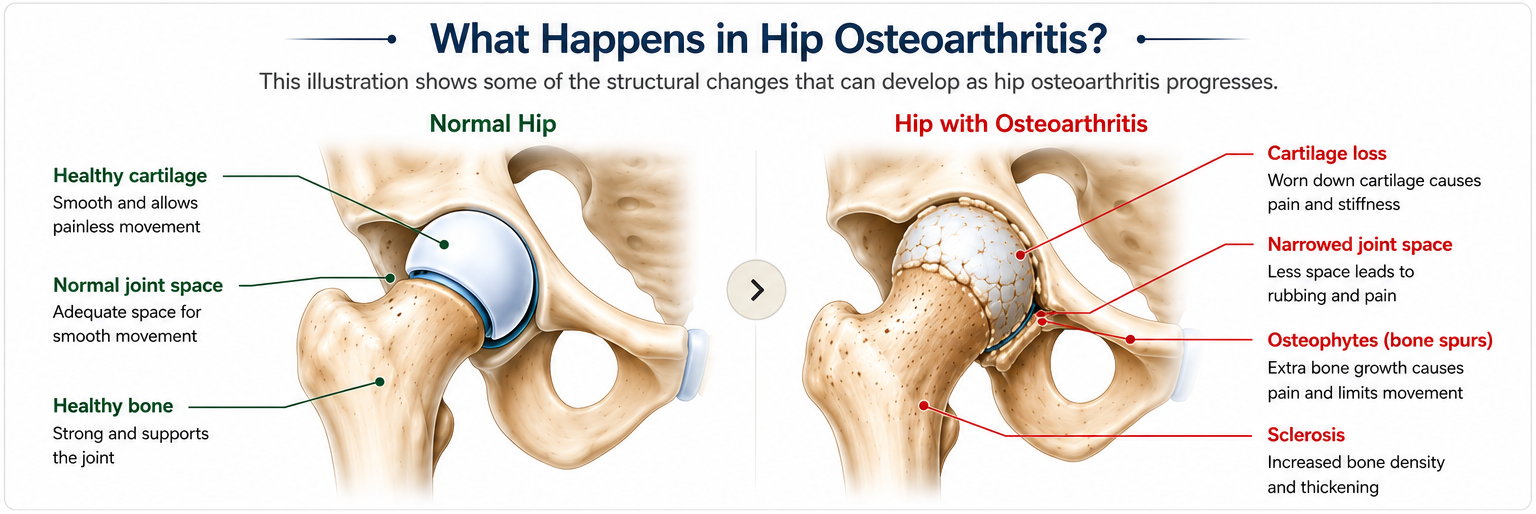
With osteoarthritis, progressive structural changes can result in cartilage loss, narrowing of the joint space, bone remodeling and osteophyte formation.
What Causes Hip Arthritis?
Possible causes include:
- Primary osteoarthritis
- Hip dysplasia
- Previous fracture or trauma
- Avascular necrosis
- Childhood or developmental hip disorders
- Inflammatory arthritis
- Previous infection in selected cases
Sometimes no single underlying cause is identified.
What Does Hip Arthritis Feel Like?
Symptoms can include:
- Groin pain
- Hip stiffness
- Pain when walking
- Reduced walking distance
- Difficulty putting on shoes and socks
- Difficulty entering or exiting a car
- Limping
- Reduced hip movement
- Pain at rest
- Night pain in advanced disease
Where Is Hip Arthritis Pain Felt?
Hip-joint pain is commonly felt in the:
- Groin
- Front of the thigh
- Buttock
- Occasionally the knee
This is clinically important because patients sometimes assume that hip arthritis must cause pain directly over the outside of the hip.
Pain over the lateral hip may arise from structures outside the joint.
Similarly, spinal disorders can produce pain around the hip and leg.
Can Hip Arthritis Cause Knee Pain?
Yes.
Pain originating from the hip can occasionally be perceived around the knee.
For unexplained knee pain, particularly when the knee examination does not explain the symptoms, the hip may also need assessment.
How Is Hip Arthritis Diagnosed?
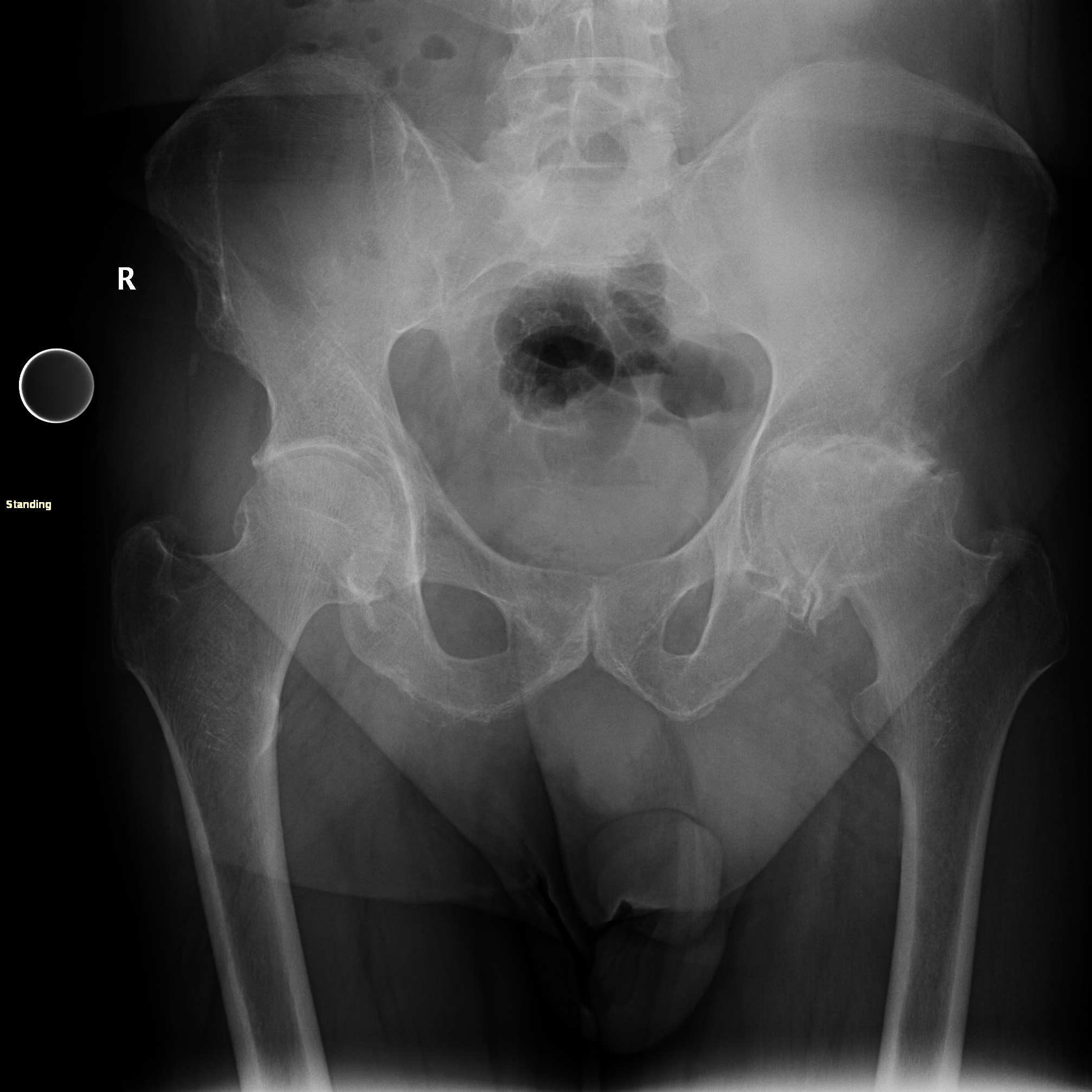
Educational example radiographs. The images alone do not determine treatment or provide individualized medical advice.
Evaluation may include:
- History
- Walking pattern
- Hip range of motion
- Areas of tenderness
- Leg length
- Muscle strength
- Examination of the knee
- Examination of the spine when relevant
X-rays of the pelvis and hip usually provide important initial information.
What Happens in Hip Osteoarthritis?
This illustration shows some of the structural changes that can develop as hip osteoarthritis progresses.
Do I Need an MRI?
Not always.
When clinical examination and X-rays clearly demonstrate advanced hip osteoarthritis, MRI may not change treatment.
MRI can be particularly useful when another condition is suspected, including earlier avascular necrosis or certain soft-tissue problems.
What Are the Nonsurgical Treatments?
Depending on the individual patient, treatment may include:
Activity Modification
Activities can be adjusted to reduce repeated aggravation while maintaining appropriate mobility.
Physiotherapy
Physiotherapy may help maintain strength, movement and function.
It cannot restore a severely destroyed joint surface.
Weight Management
When relevant, reducing excess body weight may improve mobility and general surgical health.
Medication
Appropriate analgesic or anti-inflammatory treatment may help symptoms.
Walking Aids
A cane can reduce load through a painful hip in selected patients.
Hip Injections
Image-guided intra-articular injections may provide temporary symptom relief for selected patients.
They do not reverse advanced structural arthritis.
When Is Hip Replacement Considered?
Total hip replacement may be considered when:
- Pain remains significant
- Walking becomes substantially limited
- Hip stiffness affects everyday activities
- Sleep or independence is affected
- Imaging demonstrates advanced joint damage
- Appropriate nonsurgical treatment no longer provides adequate relief
The decision should be individualized.
What Is Total Hip Replacement?
Total hip replacement replaces the damaged femoral head and acetabular joint surface with prosthetic components.
The goals include:
- Pain reduction
- Improved mobility
- Improved walking
- Restoration of useful movement
- Improved independence
Different surgical approaches and implant strategies can be used.
What Is Direct Anterior Hip Replacement?
The direct anterior approach accesses the hip from the front using an anatomical interval between muscle groups.
It can offer potential early recovery advantages in appropriately selected patients.
It is not automatically the best approach for every patient.
What If My Arthritis Is Caused by Avascular Necrosis?
Avascular necrosis is different from primary osteoarthritis.
Earlier disease may allow consideration of hip-preservation treatment in selected patients.
Once significant femoral-head collapse and secondary arthritis have occurred, total hip replacement may become more appropriate.
What If I Have Hip Dysplasia?
Hip dysplasia changes the anatomy of the socket and can lead to premature arthritis.
Replacement can still be performed when indicated, but reconstruction may require additional planning because anatomy and bone coverage can differ from a routine arthritic hip.
Does Groin Pain Mean I Have Hip Arthritis?
Not necessarily. Several conditions can cause groin pain.
Can Hip Arthritis Cause Back Pain?
Hip and spinal symptoms can overlap. Examination helps determine the dominant pain source.
Can Hip Arthritis Be Cured Without Surgery?
Nonsurgical treatment can improve symptoms but does not restore a severely damaged joint surface.
Do I Need an MRI Before Hip Replacement?
Not routinely when the diagnosis of advanced arthritis is already clear from clinical assessment and appropriate X-rays.
When Should I Consider Hip Replacement?
When pain, stiffness and loss of function remain substantial despite appropriate nonsurgical treatment.
Is the Anterior Approach Always Better?
No. Surgical approach should be individualized.
Written and medically reviewed by: Dr. Yousef Abuodeh Consultant Orthopedic Surgeon Last medically reviewed: August 31, 2026