
What Is Avascular Necrosis?
The hip is a ball-and-socket joint.
The femoral head forms the ball of the joint and depends on an adequate blood supply to maintain healthy bone.
When part of this blood supply is compromised, an area of bone can undergo osteonecrosis.
Initially, the shape of the femoral head may remain preserved.
As the disease progresses, structural weakness can lead to subchondral fracture, collapse of the femoral head and eventually degeneration of the entire hip joint.
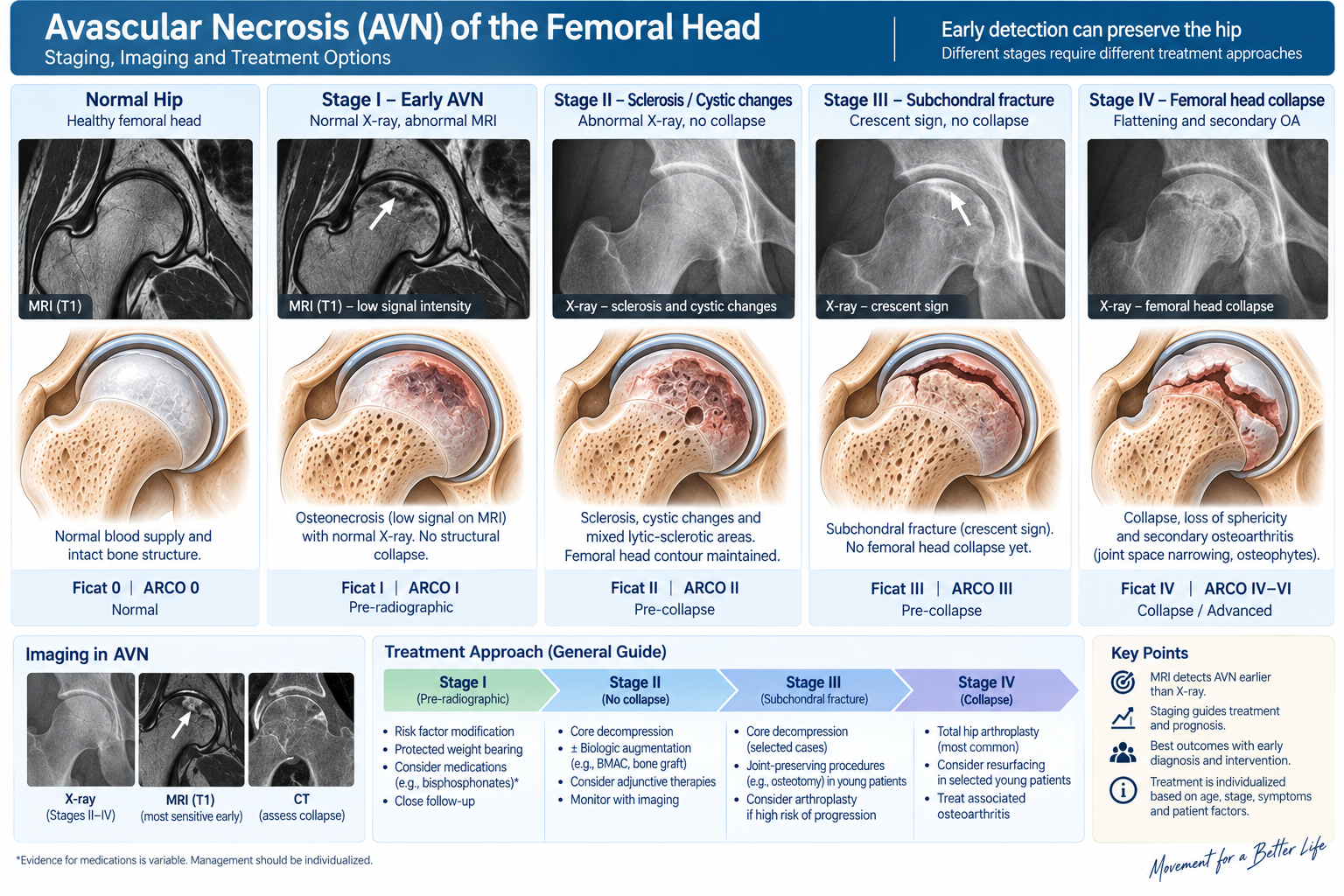
AVN stages and imaging findings
This educational illustration summarizes how AVN may progress from early MRI changes without collapse to subchondral fracture, femoral-head collapse and secondary arthritis. The displayed scans are educational examples, not diagnostic images from an individual patient.
What Causes Avascular Necrosis?
Avascular necrosis can develop in association with several conditions or risk factors.
These may include:
- Previous trauma to the hip
- Corticosteroid exposure
- Excessive alcohol exposure
- Certain blood disorders
- Some systemic medical conditions
- Previous treatments or conditions affecting blood supply to bone
In some patients, no definite cause is identified.
This is sometimes described as idiopathic avascular necrosis.
Identifying possible contributing factors remains part of the clinical assessment.
What Are the Symptoms?
Symptoms can vary according to the stage of disease.
Patients may experience:
- Groin pain
- Hip pain during walking
- Pain with weight bearing
- Reduced walking distance
- Hip stiffness
- Reduced range of motion
- Limping
- Pain at rest in more advanced disease
- Night pain in advanced cases
Early avascular necrosis may occasionally produce relatively mild symptoms despite abnormalities on imaging.
Can Avascular Necrosis Affect Both Hips?
Yes.
Avascular necrosis can affect both hips, particularly when associated with certain systemic risk factors.
Assessment of the opposite hip may be appropriate according to symptoms, risk factors and clinical context; this does not mean every patient needs routine bilateral MRI.
How Is Avascular Necrosis Diagnosed?
Evaluation begins with the patient’s history and clinical examination.
Imaging may include:
X-rays
X-rays can demonstrate structural changes, particularly once disease has progressed.
Early avascular necrosis may not always be clearly visible on plain radiographs.
MRI
MRI is particularly useful for detecting avascular necrosis before advanced structural collapse becomes visible on X-ray.
It can also help evaluate the extent of involvement of the femoral head.
CT
CT may be useful in selected cases when more detailed assessment of the bony structure or collapse is required.
The appropriate imaging strategy depends on the clinical situation.
Why Does the Stage Matter?
Avascular necrosis should not be treated as a single uniform condition.
One of the most important distinctions is whether the femoral head has maintained its structural shape or has already begun to collapse.
Before significant collapse, hip-preservation treatment may remain possible in selected patients.
Once substantial collapse and secondary arthritis have developed, preservation procedures become less predictable and total hip replacement may become the more appropriate reconstruction.
For this reason:
Early-stage and late-stage avascular necrosis may require fundamentally different treatment strategies.
Can Avascular Necrosis Heal Without Surgery?
Management depends on the cause, stage, size and location of the lesion, symptoms and individual patient factors.
Observation and nonsurgical management may be appropriate in selected circumstances.
However, established structural damage to the femoral head cannot simply be assumed to reverse with medication or physiotherapy.
Regular clinical and imaging assessment may therefore be important when a preservation strategy is chosen.
What Is Core Decompression?
Core decompression is a hip-preservation procedure that may be considered in selected pre-collapse avascular necrosis.
The procedure involves creating one or more channels into the affected region of the femoral head.
Different techniques and biological adjuncts have been described.
Core decompression is not appropriate for every patient with avascular necrosis and does not guarantee preservation of the native hip.
Its potential role depends strongly on lesion size, lesion location, disease stage and individual circumstances, and results become less predictable after meaningful structural collapse.
What Other Hip-Preservation Procedures Are Available?
Depending on the individual case, preservation strategies may include procedures designed to address the affected bone while maintaining the patient’s native hip.
The suitability of these techniques depends on factors including:
- Disease stage
- Size of the affected area
- Location of the lesion
- Presence or absence of collapse
- Patient age
- Symptoms
- Bone quality
- General health
No preservation procedure should be selected simply because the patient is young.
The structural condition of the femoral head remains critical.
When Is Hip Replacement Considered?
Total hip replacement may be considered when avascular necrosis has resulted in advanced structural collapse or secondary arthritis associated with significant symptoms.
Typical considerations include:
- Persistent pain
- Difficulty walking
- Significant stiffness
- Femoral-head collapse
- Secondary degenerative changes
- Loss of function
- Failure of appropriate previous treatment
In this situation, the objective changes from attempting to preserve the damaged femoral head to reconstructing the hip joint.
Can the Direct Anterior Approach Be Used?
Selected patients undergoing total hip replacement for avascular necrosis may be suitable for the direct anterior approach.
The decision regarding surgical approach should nevertheless be individualized.
Factors such as:
- Anatomy
- Previous surgery
- Deformity
- Bone quality
- Surgical complexity
must be considered.
The presence of avascular necrosis alone does not determine the surgical approach.
What About Avascular Necrosis in Younger Patients?
Avascular necrosis frequently creates difficult decisions in younger adults.
Preserving the natural hip is desirable when a reasonable preservation option remains.
However, repeatedly performing procedures with a low probability of success simply to postpone replacement is not necessarily beneficial.
The appropriate question is not only:
“Is the patient young?”
but also:
“Is the femoral head still structurally suitable for preservation?”
Age, disease stage, symptoms, activity requirements and expected durability of each treatment option should be considered together.
What Happens If the Femoral Head Has Already Collapsed?
Once structural collapse becomes significant, the mechanics of the hip joint change.
Progressive cartilage damage and secondary arthritis can follow.
At this stage, procedures designed purely to preserve the femoral head may provide less predictable results.
For symptomatic advanced disease, total hip replacement may therefore provide a more appropriate reconstructive option.
Is avascular necrosis the same as arthritis?
No. Avascular necrosis begins as a problem affecting bone viability in the femoral head. Advanced disease can eventually produce collapse and secondary hip arthritis.
Can AVN be seen on an X-ray?
Advanced disease often can. Earlier disease may require MRI for detection.
Does every patient with AVN need surgery?
No. Treatment depends on disease stage, symptoms, extent of involvement and individual circumstances.
Does every patient need a hip replacement?
No. Earlier-stage disease may allow consideration of preservation strategies in selected patients.
Can core decompression prevent hip replacement?
It may be useful in appropriately selected earlier-stage disease, but it does not guarantee that the condition will stop progressing.
Can AVN affect both hips?
Yes. Bilateral involvement can occur.
If I have AVN but little pain, do I still need assessment?
Clinical and imaging findings should be considered together. The absence of severe pain does not by itself establish the stage of disease.
Written and medically reviewed by: Dr. Yousef Abuodeh Consultant Orthopedic Surgeon Last medically reviewed: September 2, 2026