
What Is a Bucket-Handle Meniscus Tear?
The term describes a longitudinal meniscus tear in which the inner torn fragment displaces away from its normal position.
The appearance is sometimes compared with the handle of a bucket.
These tears can involve either the:
- Medial meniscus
- Lateral meniscus
They may occur alone or together with ligament injuries such as an ACL tear.
A displaced bucket-handle tear
In a bucket-handle tear, a longitudinal meniscus fragment can displace toward the center of the knee. That displacement may restrict motion or produce a truly locked knee.
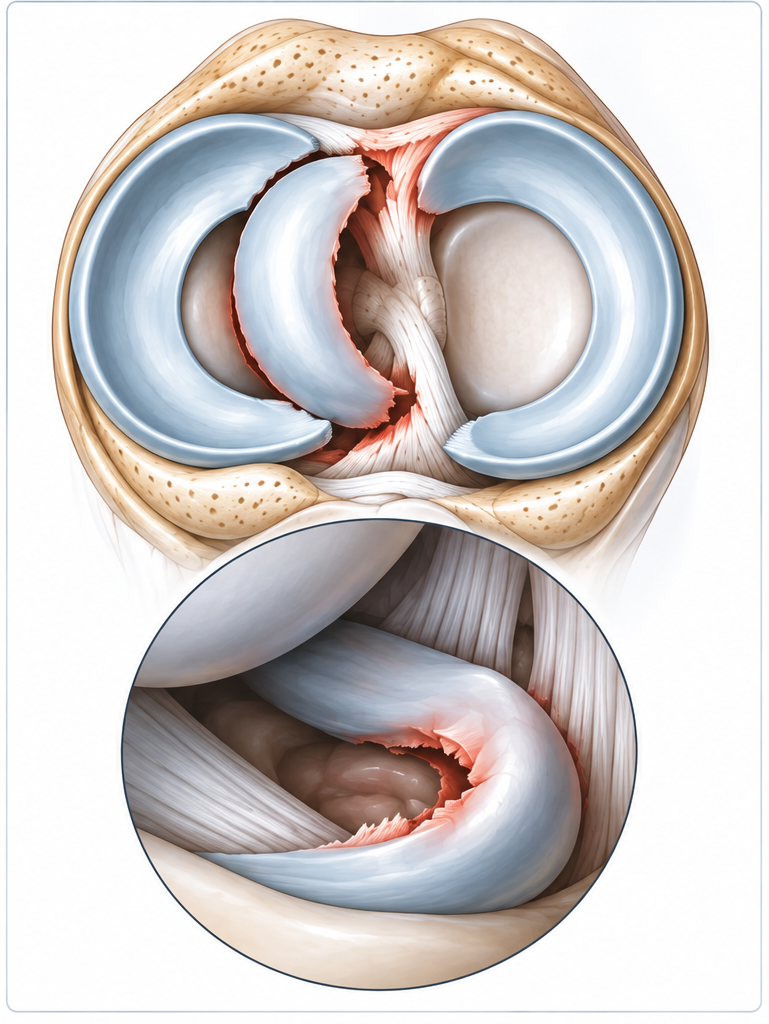
What Causes a Bucket-Handle Tear?
In younger patients, the tear often follows a twisting or pivoting knee injury.
Mechanisms can include:
- Sports
- Sudden direction change
- Twisting on a planted foot
- Deep flexion under load
In other patients, degenerative changes may contribute to meniscal tearing.
What Are the Symptoms?
Symptoms may include:
- Sudden knee pain
- Swelling
- Joint-line tenderness
- Catching
- Inability to fully straighten the knee
- A sensation that something is blocking movement
- Difficulty walking
The degree of locking depends on displacement of the fragment.
What Is a Locked Knee?
A true mechanically locked knee has an intra-articular mechanical block preventing full motion, particularly extension.
With a displaced bucket-handle tear, the meniscal fragment can block extension.
This differs from a knee that is difficult to move because of:
- Pain
- Swelling
- Guarding
- Muscle spasm
Distinguishing true locking from painful limitation is clinically important.
Is a Locked Knee an Emergency?
A genuinely locked knee from a displaced meniscus tear deserves timely orthopedic assessment.
The urgency depends on:
- Clinical findings
- Injury pattern
- Associated injuries
- Duration
- Individual circumstances
Not every painful knee, limited knee, or bucket-handle tear is an emergency.
How Is It Diagnosed?
Evaluation includes:
- Injury history
- Range of motion
- Joint-line tenderness
- Meniscus tests when possible
- Ligament examination
- Assessment of swelling
MRI is particularly useful for confirming the displaced tear and identifying associated injuries.
What Can MRI Show?
MRI may demonstrate:
- Displaced meniscal fragment
- Tear location
- Extent of tear
- Associated ACL injury
- Cartilage condition
- Other internal knee injuries
The final assessment of tissue quality and repairability may nevertheless occur during arthroscopy.
Can a Bucket-Handle Tear Be Repaired?
Many bucket-handle tears can be considered for repair.
Repairability depends on:
- Tear location
- Tissue quality
- Chronicity
- Reducibility
- Blood supply
- Patient factors
- Associated injuries
Not every displaced tear is repairable.
Why Try to Save the Meniscus?
The meniscus contributes to:
- Load distribution
- Shock absorption
- Stability
- Cartilage protection
Removing substantial meniscal tissue permanently reduces these functions.
When a displaced tear can be anatomically reduced and has reasonable healing potential, preservation is therefore an important objective.
What Is Meniscus Repair?
During arthroscopy, the displaced meniscus can be reduced to its anatomical position.
Sutures or other repair techniques are then used to stabilize the tear while biological healing occurs.
Different techniques include:
- All-inside repair
- Inside-out repair
- Other selected suture techniques
The method depends on the tear.
When Is Partial Meniscectomy Required?
If tissue is:
- Severely damaged
- Degenerative
- Nonviable
- Irreducible
- Otherwise unsuitable for repair
limited removal of the irreparable portion may be necessary.
The objective should still be to preserve as much functional meniscus as reasonably possible.
What If the ACL Is Also Torn?
Bucket-handle tears can occur with ACL injuries.
The treatment plan should consider both problems.
In selected patients, the meniscus can be repaired and ACL reconstruction performed during the same operation.
In other situations, treatment timing may need to be individualized.
Why Does ACL Stability Matter for Meniscus Healing?
The ACL and menisci contribute together to knee stability.
Persistent instability can expose the meniscus to abnormal stresses.
When clinically appropriate, addressing both the unstable ACL and repairable meniscus can therefore be important.
What If the Tear Has Been Locked for Some Time?
Chronic displaced tears can become more difficult to reduce and tissue quality may deteriorate.
However, chronicity alone does not prove irreparability.
Arthroscopic assessment may still identify repairable tissue in selected cases.
What Happens After Meniscus Repair?
Rehabilitation depends on:
- Tear location
- Repair technique
- Stability of repair
- Associated ACL reconstruction
- Other procedures
Temporary restrictions may be placed on:
- Weight bearing
- Knee flexion
- Deep squatting
- Sporting activity
The objective is to protect healing without unnecessarily compromising recovery.
How Long Does It Take to Return to Sport?
Return depends on:
- Meniscal healing
- Strength
- Range of motion
- Symptoms
- Associated procedures
- Functional testing
A repaired meniscus requires biological healing, so feeling better does not necessarily mean the tissue is ready for unrestricted sport.
Can a Bucket-Handle Repair Fail?
Yes.
Healing is not guaranteed.
Factors can include:
- Tissue quality
- Tear location
- Chronicity
- Biological healing potential
- Knee stability
- Rehabilitation
- Further injury
Recurrent symptoms require reassessment.
Does a Bucket-Handle Tear Always Lock the Knee?
No. Displacement varies.
Can the Meniscus Move Back Into Place by Itself?
A displaced fragment can occasionally change position, but this does not necessarily mean the tear has healed.
Does Every Bucket-Handle Tear Need Surgery?
Treatment depends on displacement, symptoms, locking, tissue characteristics and individual circumstances.
Is Repair Better Than Removal?
When the tear is reasonably repairable, preservation is generally desirable because the meniscus has important mechanical functions.
Can an Old Bucket-Handle Tear Still Be Repaired?
Sometimes. Chronicity influences repairability but does not determine it alone.
Can ACL Reconstruction and Meniscus Repair Be Performed Together?
Yes, in selected patients.
Written and medically reviewed by: Dr. Yousef Abuodeh Consultant Orthopedic Surgeon Last medically reviewed: September 2, 2026