
What Is Osteosarcoma?
Osteosarcoma is a malignant tumor arising in bone.
It differs from metastatic bone disease, in which a cancer originating elsewhere in the body spreads to the skeleton.
Osteosarcoma originates from malignant bone-forming cells.
There are different subtypes and patterns of osteosarcoma, and treatment depends on the specific diagnosis and stage.
Where Does Osteosarcoma Occur?
Osteosarcoma can develop in different bones.
Common sites include areas around the knee, particularly the:
- Distal femur
- Proximal tibia
It can also affect:
- Proximal humerus
- Pelvis
- Other bones
The anatomical location strongly influences surgical planning and reconstruction.
What Are the Symptoms?
Possible symptoms include:
- Persistent localized bone pain
- Progressive pain
- Swelling
- A palpable mass
- Reduced function
- Limping when a lower limb is involved
- Restricted movement near a joint
- Pathological fracture in some cases
These symptoms are not specific to osteosarcoma.
Many much more common benign conditions can cause bone pain.
Does Bone Pain Mean Osteosarcoma?
No.
Bone and joint pain are extremely common and are usually caused by conditions other than malignant bone tumors.
Persistent or otherwise concerning symptoms should nevertheless be appropriately assessed rather than self-diagnosed.
How Is Osteosarcoma Investigated?
Evaluation may include:
- Clinical history
- Examination
- Plain radiographs
- MRI of the involved region
- CT in selected circumstances
- Appropriate staging investigations
- Biopsy
The sequence of investigation matters.
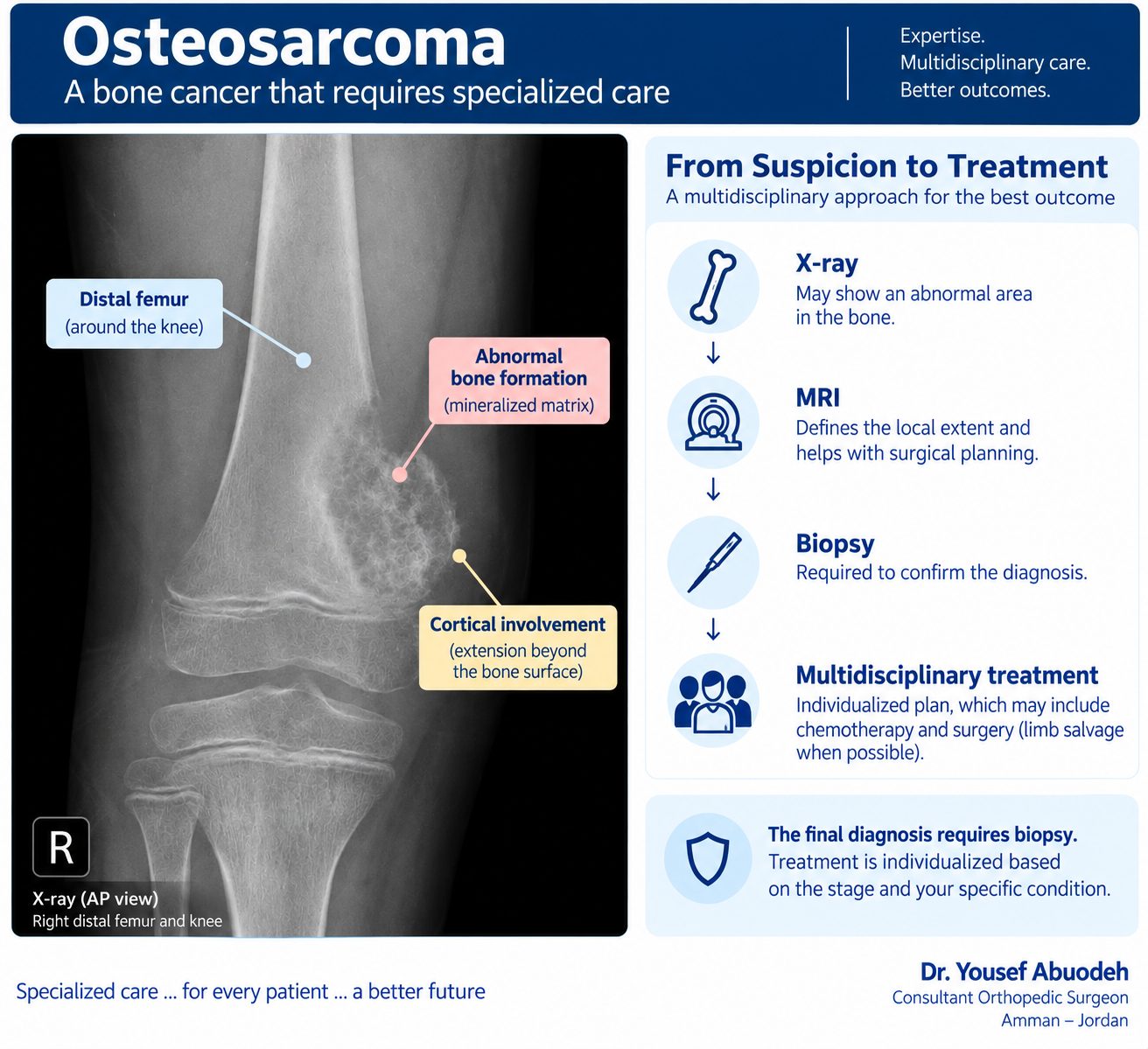
From suspicion to coordinated treatment
A suspicious bone lesion is assessed in sequence: plain radiographs identify concerning features, MRI defines local extent, a correctly planned biopsy confirms diagnosis, and the multidisciplinary team coordinates systemic treatment and surgery according to stage and individual circumstances.
What Can an X-Ray Show?
Radiographs may demonstrate an aggressive bone lesion.
Features can include:
- Bone destruction
- Abnormal bone formation
- Cortical disruption
- Periosteal reaction
- Soft-tissue extension
No single radiographic feature alone establishes the final diagnosis.
Why Is MRI Important?
MRI helps determine the local extent of disease.
It can evaluate:
- Extent within the bone
- Soft-tissue component
- Relationship to the joint
- Relationship to muscles
- Relationship to nerves and blood vessels
- Other local anatomical features relevant to surgery
MRI is therefore important for local staging and surgical planning.
Why Is Biopsy Required?
Imaging can strongly suggest a malignant bone tumor, but tissue diagnosis is generally required before definitive treatment.
The biopsy should be carefully planned.
When malignancy is possible, the biopsy tract may need to be removed during definitive tumor surgery.
For this reason, biopsy should be coordinated with the definitive treatment strategy whenever possible.
What Does Staging Mean?
Staging evaluates the extent of disease beyond the primary tumor.
The exact staging investigations depend on the clinical situation and treatment protocol.
Chest imaging is an important component of staging because the lungs are a common site of metastatic disease.
Staging information influences treatment planning and prognosis.
How Is Osteosarcoma Treated?
For conventional high-grade osteosarcoma, treatment commonly includes systemic chemotherapy combined with surgical resection of the primary tumor.
Chemotherapy is commonly given before surgery and continued after surgery according to the oncology protocol and individual clinical circumstances.
Treatment varies for different osteosarcoma subtypes, anatomical situations and patient factors.
Why Is Chemotherapy Important?
For conventional high-grade osteosarcoma, systemic chemotherapy is a standard component of multidisciplinary treatment because management must address both the primary tumor and the risk of microscopic systemic disease.
The specific regimen and timing are determined by the medical oncology team according to the treatment protocol and individual patient.
What Does Surgery Involve?
The objective of surgery is appropriate removal of the tumor while planning the best feasible reconstruction.
Surgery depends on:
- Tumor location
- Tumor size and extent
- Relationship to neurovascular structures
- Joint involvement
- Response to systemic treatment
- Remaining bone and soft tissues
- Expected function
The reconstruction is planned around the oncologically appropriate resection.
Can the Limb Be Saved?
Limb-salvage surgery is possible for many patients when an appropriate tumor resection and useful reconstruction can be achieved.
Reconstruction may involve:
- Endoprosthetic replacement
- Megaprosthesis
- Biological reconstruction
- Internal fixation
- Soft-tissue reconstruction
- Other specialized techniques
However, limb preservation should not compromise necessary tumor clearance.
When Might Amputation Be Required?
Amputation can remain appropriate in selected situations.
Factors can include:
- Tumor extent
- Involvement of critical structures
- Infection
- Previous surgery
- Reconstructive feasibility
- Expected limb function
The decision should be individualized and discussed within the multidisciplinary treatment plan.
What Is a Megaprosthesis?
After removal of a large segment of bone and an adjacent joint, reconstruction may require a specialized modular endoprosthesis.
This can replace both the removed bone segment and the joint.
Examples include:
- Distal femoral replacement
- Proximal tibial replacement
- Proximal femoral replacement
What Does Tumor Necrosis After Chemotherapy Mean?
After preoperative chemotherapy and tumor resection, pathology can assess the response of the tumor to treatment.
The amount of tumor necrosis provides important information about treatment response.
This assessment is performed on the resected specimen and interpreted within the overall oncology treatment plan.
Histologic response is interpreted together with stage, surgical findings and the overall treatment protocol.
What Happens After Surgery?
Care can include:
- Wound management
- Rehabilitation
- Continued oncology treatment
- Surveillance imaging
- Monitoring of reconstruction
- Long-term oncologic follow-up
The rehabilitation program depends on the resection and reconstruction performed.
Can Osteosarcoma Come Back?
Local recurrence and distant metastatic disease are important concerns during follow-up.
Surveillance is therefore a structured part of treatment after completion of initial therapy.
Why Is Multidisciplinary Care Important?
Management may involve:
- Orthopedic oncology
- Medical oncology
- Musculoskeletal radiology
- Pathology
- Plastic and reconstructive surgery
- Vascular surgery in selected cases
- Rehabilitation
- Other specialties when required
The objective is to coordinate cancer treatment and reconstruction from the beginning.
Is Osteosarcoma Always Found in Children?
No. It is particularly associated with adolescents and young adults but can occur at other ages.
Is Every Bone Mass Osteosarcoma?
No. Most bone lesions are not osteosarcoma.
Can MRI Diagnose Osteosarcoma Without Biopsy?
MRI is essential for evaluation but tissue diagnosis is generally required before definitive oncologic treatment.
Can Osteosarcoma Be Treated Without Amputation?
Many patients can undergo limb-salvage surgery when an oncologically appropriate resection and reconstruction are feasible.
Does Surgery Alone Treat Osteosarcoma?
Conventional high-grade osteosarcoma commonly requires multidisciplinary treatment including systemic chemotherapy and surgery.
Can Osteosarcoma Spread to the Lungs?
Yes. The lungs are an important site evaluated during staging and surveillance.
Written and medically reviewed by: Dr. Yousef Abuodeh Consultant Orthopedic Surgeon Last medically reviewed: September 2, 2026