
What Is a Bone Tumor?
Bone tumors arise from abnormal growth of cells involving bone.
They may be:
- Benign
- Locally aggressive
- Malignant
Other conditions can also resemble tumors on imaging.
For this reason, the presence of a “lesion” does not automatically establish a tumor diagnosis.
How Are Bone Tumors Discovered?
A lesion may be discovered because of:
- Pain
- Swelling
- A palpable mass
- Fracture
- Imaging after an injury
- Imaging performed for an unrelated medical problem
Incidental discovery is common for several benign bone lesions.
What Are Benign and Locally Aggressive Bone Lesions?
Bone lesions span a spectrum of biological behavior.
Benign tumors and tumor-like conditions can include:
- Osteochondroma
- Enchondroma
- Chondroblastoma
- Simple bone cyst
- Aneurysmal bone cyst
- Fibrous dysplasia
Some lesions, including giant cell tumor of bone, may be classified as intermediate or locally aggressive and require different treatment and surveillance.
The classification and behavior of individual lesions vary.
A non-malignant diagnosis does not necessarily mean treatment is never required.
When Can a Benign Lesion Require Treatment?
Treatment may be considered when a lesion:
- Causes significant symptoms
- Progressively enlarges
- Weakens bone
- Creates fracture risk
- Produces deformity
- Compresses important structures
- Behaves locally aggressively
- Remains diagnostically uncertain
Other benign lesions can be monitored without surgery.
What Are Malignant Bone Tumors?
Primary malignant bone tumors begin in bone.
Examples include:
- Osteosarcoma
- Chondrosarcoma
- Ewing sarcoma
These diagnoses require specialized staging and treatment planning.
Cancer can also spread from another organ to bone. This is metastatic bone disease and differs from a primary bone sarcoma.
What Symptoms Can a Bone Tumor Cause?
Symptoms can include:
- Persistent localized pain
- Night pain
- Swelling
- Palpable mass
- Reduced function
- Pathological fracture
However, symptoms alone cannot determine whether a lesion is benign or malignant.
Some malignant lesions may initially cause relatively nonspecific symptoms, while some benign lesions can be painful.
What Is a Pathological Fracture?
A pathological fracture occurs when bone breaks through an area weakened by disease.
Possible causes include:
- Benign bone lesions
- Primary malignant bone tumors
- Metastatic cancer
- Other bone disorders
When a fracture occurs through an unexplained lesion, determining the diagnosis is important before definitive reconstruction whenever clinically possible.
How Are Bone Tumors Investigated?
Assessment may include:
- Clinical history
- Examination
- X-rays
- MRI
- CT
- Laboratory investigations
- Staging studies when appropriate
- Biopsy when required
The investigation should be tailored to the lesion.
What Features Are Assessed on X-Ray?
Important features can include:
- Anatomical location
- Position within the bone
- Lesion margins
- Pattern of bone destruction
- Matrix
- Cortical involvement
- Periosteal reaction
- Pathological fracture
These features can provide important clues regarding biological behavior.
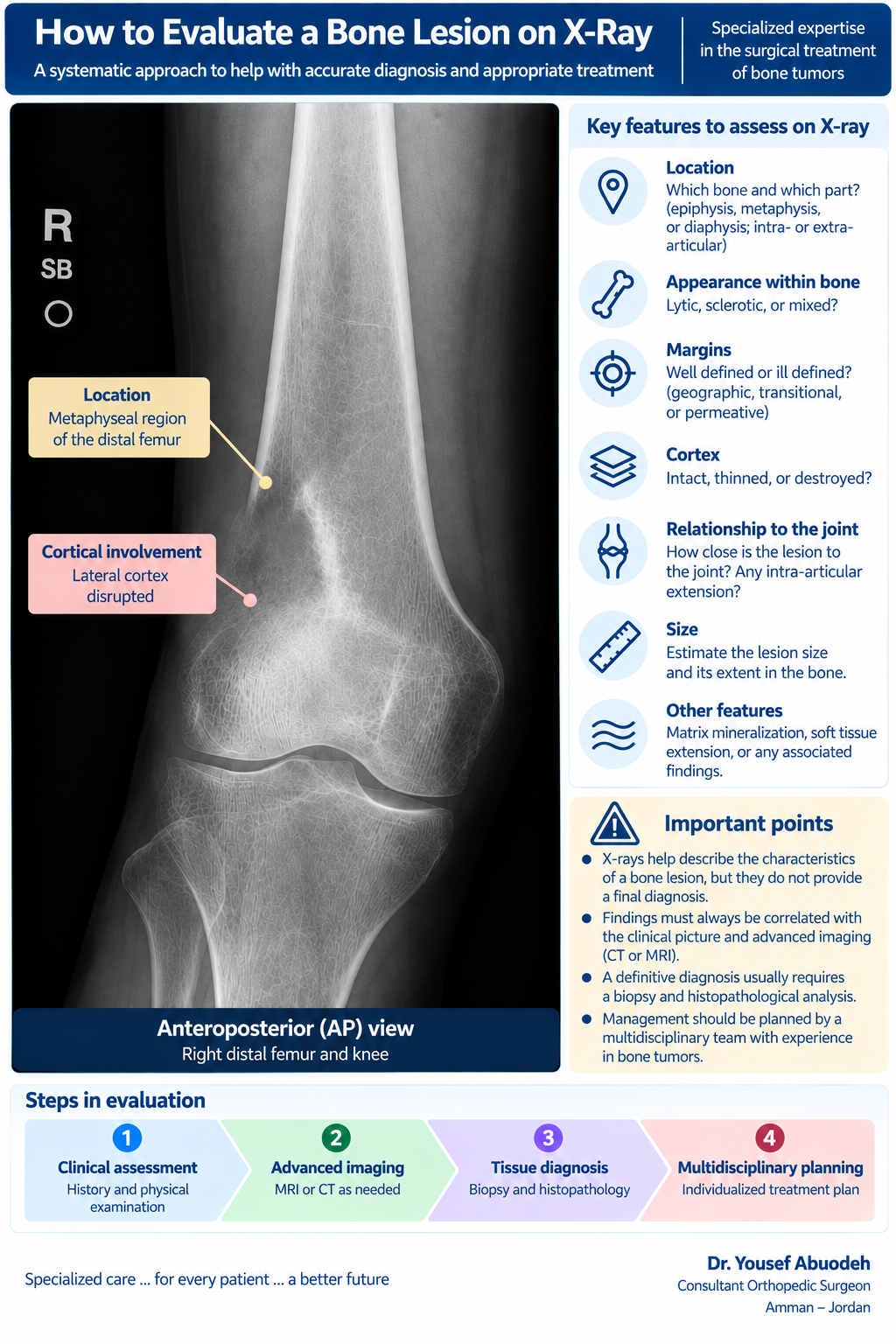
Systematic X-ray evaluation of a bone lesion
Radiograph review considers the lesion location, appearance, margins, cortex, relationship to the joint, size, matrix and associated findings. These features guide the next step but do not provide a final diagnosis without clinical correlation and, when required, further imaging or biopsy.
When Is MRI Needed?
MRI can help evaluate:
- Extent within bone
- Bone marrow involvement
- Soft-tissue extension
- Relationship to joints
- Relationship to neurovascular structures
- Internal lesion characteristics
MRI is particularly important when an aggressive tumor is suspected or surgery is being considered.
When Is CT Useful?
CT can provide additional information regarding:
- Cortical bone
- Mineralization
- Tumor matrix
- Subtle fractures
- Complex anatomy
CT and MRI answer different questions and may complement one another.
Does Every Bone Tumor Require Biopsy?
No.
Some benign lesions can be diagnosed with sufficient confidence from clinical and imaging characteristics.
Others require tissue diagnosis.
Unnecessary biopsy should be avoided, but necessary biopsy should not be delayed simply because a lesion might be benign.
The decision should be individualized.
What Is Observation?
Observation may involve:
- Clinical follow-up
- Repeat X-rays
- Interval MRI in selected cases
- Monitoring symptoms
The purpose is to document stability when immediate intervention is not required.
A decision to observe is still a clinical management decision rather than “doing nothing.”
How Are Bone Tumors Treated?
Treatment depends entirely on diagnosis and behavior.
Options may include:
- Observation
- Curettage
- Bone graft or substitute
- Internal fixation
- Tumor resection
- Limb-salvage reconstruction
- Megaprosthesis
- Systemic cancer treatment
- Radiotherapy for selected diagnoses
There is no single operation called “bone tumor surgery.”
Is Every Bone Tumor Cancer?
No. Many bone tumors and bone lesions are benign.
Can an Incidental Bone Lesion Be Ignored?
Not automatically. Its imaging characteristics and clinical context should first establish whether observation is appropriate.
Can a Benign Tumor Grow?
Yes. Some benign lesions can enlarge or behave locally aggressively.
Can a Bone Tumor Cause a Fracture?
Yes. Lesions that weaken bone can increase fracture risk.
Does a Bone Tumor Always Hurt?
No. Some are discovered incidentally without symptoms.
Do I Need a Biopsy?
Only when the diagnosis and treatment plan require tissue confirmation.
Written and medically reviewed by: Dr. Yousef Abuodeh Consultant Orthopedic Surgeon Last medically reviewed: September 2, 2026